
mcp-pinot
MCP Server for Apache Pinot
Documentation
Pinot MCP Server




Table of Contents
- Overview
- Features
- Quick Start
- Configuration Reference
- Docker Build
- Claude Desktop Integration
- Try a Prompt
- Security and Vulnerability Reporting
- Developer Notes
Overview
This project is a Python-based Model Context Protocol (MCP) server for interacting with Apache Pinot. It is built using the FastMCP framework. It is designed to integrate with Claude Desktop to enable real-time analytics and metadata queries on a Pinot cluster.
It allows you to
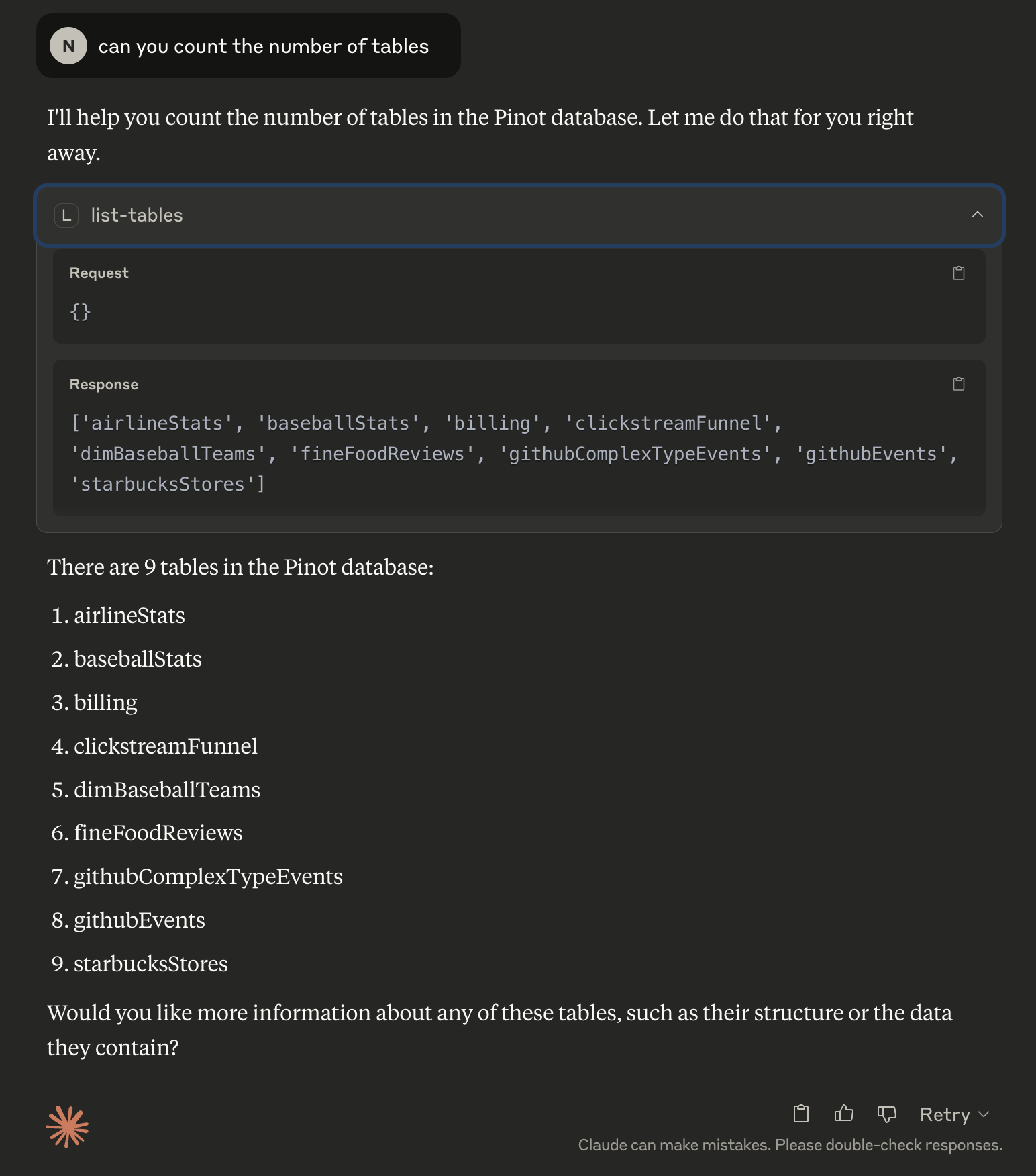
- List tables, segments, and schema info from Pinot
- Execute read-only SQL queries
- View index/column-level metadata
- Designed to assist business users via Claude integration
- and much more.
Features
- Every tool advertises typed input and output JSON Schemas, MCP risk annotations,
and failure-recovery guidance for agent planning.
- Large query, table, segment-name, and segment-metadata responses use bounded
pages with continuation metadata instead of returning unbounded agent context.
- Read-only SQL is parsed and enforced before execution; validation, permission,
and transient connectivity errors are surfaced as actionable MCP errors.
- Every mutating tool supports `dry_run`; always preview the exact target and
payload before applying. Applying requires the preview's short-lived, one-time
`confirmation_token`, including for table-filter reloads. A preview is not a
guarantee that Pinot will accept the later write.
- Single-purpose schema and table-config inspection tools avoid ambiguous combined
operations: use `get_schema` and `get_table_config` independently.
MCP Tool Contract
Tool names are case-sensitive and use underscores. Version 4 renamed four tools
to make every operation verb-first; clients using the former noun-first names must
update their calls.
| Tool | Purpose |
|---|---|
| `test_connection` | Diagnose broker, controller, and query connectivity. |
| `list_tables` | List visible Pinot table names. |
| `get_schema` | Get one table's column schema. |
| `get_table_config` | Get one table's indexing and ingestion configuration. |
| `get_table_size` | Get reported and estimated storage size for one table. |
| `list_segments` | List exact segment names for one table. |
| `list_segment_metadata` | Page through metadata for a table's segments. |
| `get_segment_index_metadata` | Inspect per-column indexes for one exact segment. |
| `read_query` | Run one read-only Pinot SQL query. |
| `create_schema` / `update_schema` | Preview or apply schema changes. |
| `create_table_config` / `update_table_config` | Preview or apply table-config changes. |
| `reload_table_filters` | Preview or apply the configured table-filter YAML. |
For every schema, table-config, or table-filter change, first call the same tool
with `dry_run=true`, present the preview to the user, and call it with
`dry_run=false` and the preview's one-time `confirmation_token` only after
confirmation. Editing a table-filter file after preview invalidates its token.
Pinot performs authoritative validation during table/schema apply calls, so a
write can still fail after a successful preview.
Pinot MCP in Action
See Pinot MCP in action below:
Fetching Metadata
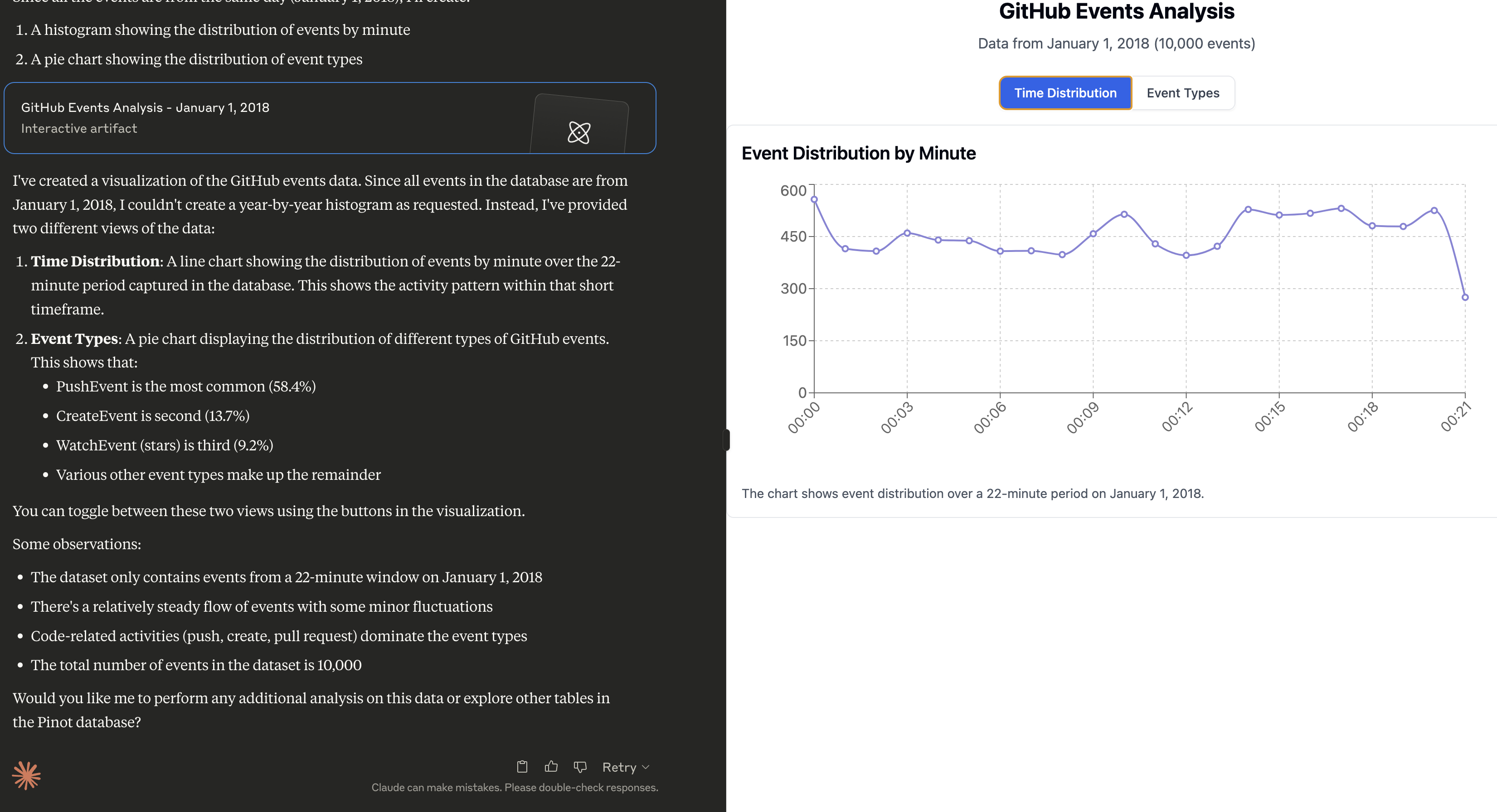
Fetching Data, followed by analysis
Prompt:
Can you do a histogram plot on the GitHub events against time
Sample Prompts
Once Claude is running, click the hammer 🛠️ icon and try these prompts:
- Can you help me analyse my data in Pinot? Use the Pinot tool and look at the list of tables to begin with.
- Can you do a histogram plot on the GitHub events against time
Quick Start
Prerequisites
Install uv (if not already installed)
uv is a fast Python package installer and resolver, written in Rust. It's designed to be a drop-in replacement for pip with significantly better performance.
curl -LsSf https://astral.sh/uv/install.sh | sh

# Reload your bashrc/zshrc to take effect. Alternatively, restart your terminal
# source ~/.bashrc
Installation
# Clone the repository
git clone https://github.com/startreedata/mcp-pinot.git
cd mcp-pinot
uv pip install -e . # Install dependencies

# For development dependencies (including testing tools), use:
# uv pip install -e .[dev]
Configure Pinot Cluster
The MCP server expects a uvicorn config style `.env` file in the root directory to configure the Pinot cluster connection. This repo includes a sample `.env.example` file that assumes a pinot quickstart setup.
mv .env.example .envConfiguration Reference
The server loads configuration from environment variables and from a `.env` file
found from the current working directory. Process environment variables take
precedence over `.env`, so deployment-time settings cannot be silently replaced
by a checked-out file.
Common Profiles
| Use case | Required settings | Notes | ||
|---|---|---|---|---|
| Claude Desktop | `MCP_TRANSPORT=stdio` | Default and recommended for local desktop use; no HTTP listener is started. | ||
| Local HTTP | `MCP_TRANSPORT=http`, `MCP_HOST=127.0.0.1` | Explicit local web profile. Accessible only from the same machine. | ||
| Remote HTTP/HTTPS | `MCP_TRANSPORT=http`, `MCP_HOST=0.0.0.0`, `MCP_ALLOWED_HOSTS=`, `AUTH_PROVIDER=oauth`\ | `static`\ | `oauth+static` | The server refuses non-loopback HTTP/HTTPS binds unless an auth provider is active, and a wildcard bind requires an explicit Host allowlist. Use `oauth+static` to serve interactive users and one trusted backend at once. Use TLS directly or an authenticated reverse proxy. |
| Helm exposure | `service.enabled=true`, `mcp.host=0.0.0.0`, `mcp.oauth.enabled=true` | Helm defaults are local-only and render no Service unless exposure is explicitly enabled. |
Pinot Connection
| Variable | Default | Description |
|---|---|---|
| `PINOT_CONTROLLER_URL` | `http://localhost:9000` | Pinot controller endpoint used for metadata and table/schema operations. |
| `PINOT_BROKER_URL` | `http://localhost:8000` | Pinot broker endpoint used for SQL queries. |
| `PINOT_BROKER_HOST` | Parsed from `PINOT_BROKER_URL` | Optional host override for the broker connection. |
| `PINOT_BROKER_PORT` | Parsed from `PINOT_BROKER_URL` | Optional port override for the broker connection. |
| `PINOT_BROKER_SCHEME` | Parsed from `PINOT_BROKER_URL` | Optional scheme override, usually `http` or `https`. |
| `PINOT_USERNAME` / `PINOT_PASSWORD` | unset | Basic authentication for Pinot. |
| `PINOT_TOKEN` | unset | Bearer or raw token for Pinot; takes precedence over `PINOT_TOKEN_FILENAME`. |
| `PINOT_TOKEN_FILENAME` | unset | File containing a Pinot token. A missing or empty file logs a warning and continues without token auth. |
| `PINOT_DATABASE` | empty | Optional database header for multi-database Pinot deployments. |
| `PINOT_USE_MSQE` | `false` | Enables Pinot multi-stage query engine query option. |
| `PINOT_REQUEST_TIMEOUT` | `60` | HTTP request timeout in seconds. |
| `PINOT_CONNECTION_TIMEOUT` | `60` | HTTP connection timeout in seconds. |
| `PINOT_QUERY_TIMEOUT` | `60` | SQL query timeout in seconds. |
MCP Server
| Variable | Default | Description |
|---|---|---|
| `MCP_TRANSPORT` | `stdio` | Transport mode. Use `stdio` for desktop clients and `http` for Streamable HTTP clients. |
| `MCP_HOST` | `127.0.0.1` | HTTP bind host. Set `0.0.0.0` only with an auth provider enabled. |
| `MCP_PORT` | `8080` | HTTP listen port. |
| `MCP_PATH` | `/mcp` | MCP HTTP path. |
| `MCP_ALLOWED_HOSTS` | exact host[:port] of a concrete bind | Comma-separated Host authorities accepted at the MCP endpoint. A wildcard bind (`0.0.0.0`, `::`) has no inferable public authority, so it defaults to empty and the server exits at startup until you list the names clients use, e.g. `mcp.example.com,mcp.example.com:443`. |
| `MCP_ALLOWED_ORIGINS` | unset | Comma-separated browser `Origin` values accepted. Empty rejects requests that send `Origin` while still allowing clients that omit it. |
| `MCP_SSL_KEYFILE` | unset | TLS private key path. Requires `MCP_SSL_CERTFILE`. |
| `MCP_SSL_CERTFILE` | unset | TLS certificate path. Requires `MCP_SSL_KEYFILE`. |
| `MCP_LOG_LEVEL` | `INFO` | Application log level: `DEBUG`, `INFO`, `WARNING`, `ERROR`, or `CRITICAL`. Logs go to stderr so STDIO protocol output remains valid. |
| `MCP_RATE_LIMIT_RPS` / `MCP_RATE_LIMIT_BURST` | `10` / `20` | Per-principal (authenticated) or per-peer (loopback HTTP) tool-call rate and burst limits. |
| `MCP_RATE_LIMIT_MAX_CLIENTS` | `10000` | Maximum in-memory client buckets; least-recently-used buckets are evicted. |
| `MCP_RATE_LIMIT_IDLE_TTL_SECONDS` | `600` | Idle time before a rate-limit bucket can be evicted. |
| `MCP_CONFIRMATION_TTL_SECONDS` | `300` | Confirmation-token lifetime, constrained to 30–3600 seconds. Tokens are process-bound and intentionally fail after restart. |
Authentication
An auth provider is required before binding HTTP or HTTPS to a non-loopback host.
| Variable | Default | Description |
|---|---|---|
| `AUTH_PROVIDER` | unset | Active auth provider: `none` (default), `oauth`, `static`, or `oauth+static`. Some provider is required before a non-loopback bind. |
| `oauth+static` accepts both an OIDC login and the shared token on one deployment — the usual hosted case, where people use a browser and one trusted backend cannot. Either spelling works; the shared secret is checked first, and each credential keeps its own scopes (`MCP_STATIC_SCOPES` vs `OAUTH_GRANTED_SCOPES`). | ||
| `MCP_STATIC_TOKEN` | empty | Shared bearer secret for `AUTH_PROVIDER=static` — a service-to-service caller sends it as `Authorization: Bearer `. Required when the static provider is active. |
| `MCP_STATIC_SCOPES` | `pinot:read pinot:write pinot:admin` | Space- or comma-separated scopes granted to the static principal. Use `pinot:read` for a read-only service. |
| `OAUTH_ENABLED` | `false` | Legacy flag; `true` is equivalent to `AUTH_PROVIDER=oauth`. Enables OAuth authentication. |
| `OAUTH_CLIENT_ID` | empty | OAuth client ID. |
| `OAUTH_CLIENT_SECRET` | empty | OAuth client secret. |
| `OAUTH_BASE_URL` | `http://localhost:8080` | Public base URL for this MCP server. |
| `OAUTH_AUTHORIZATION_ENDPOINT` | empty | Upstream authorization endpoint. |
| `OAUTH_TOKEN_ENDPOINT` | empty | Upstream token endpoint. |
| `OAUTH_JWKS_URI` | empty | JWKS URI used for token verification. |
| `OAUTH_ISSUER` | empty | Expected token issuer. |
| `OAUTH_AUDIENCE` | canonical MCP resource URI | Audience tokens are validated against. Defaults to `OAUTH_BASE_URL` (without a trailing slash) plus `MCP_PATH`, which is what RFC 9728 metadata advertises. Set it explicitly when the provider issues a different `aud` — many (Dex among them) set it to the client ID; the server logs a warning and honours your value. |
| `OAUTH_GRANTED_SCOPES` | `pinot:read pinot:write pinot:admin` | Pinot scopes granted to every principal this provider authenticates, unioned onto the scopes the token already carries. Needed because general-purpose OIDC providers issue a fixed scope catalog and cannot mint `pinot:*`, so without a grant every tool call from a valid user would be denied. Set to `pinot:read` for a read-only deployment. |
| `OAUTH_EXTRA_AUTH_PARAMS` | unset | Optional JSON object with additional authorization parameters. |
Table Filtering
| Variable | Default | Description |
|---|---|---|
| `PINOT_TABLE_FILTER_FILE` | unset | YAML file with `included_tables` glob patterns. If configured and missing, startup fails. |
See SECURITY.md for the production exposure checklist and
vulnerability reporting process.
Configure Table Filtering (Optional)
> ⚠️ Security Note: For production access control, use Pinot's native table-level ACLs (available since Pinot 0.8.0+). Table filtering in this MCP server is a convenience feature for organizing tables and improving UX, not a security boundary. It uses best-effort SQL parsing and should not be relied upon for security.
Table filtering allows you to control which Pinot tables are visible through the MCP server. This is useful for:
- Reduce Cognitive Load: Focus on relevant tables when your Pinot cluster has hundreds or thousands of tables
- Multi-Tenancy UX: Run multiple MCP server instances against the same Pinot cluster, each showing different table subsets for different teams or use cases
- Environment Separation: Deploy different MCP server instances (dev, staging, prod) that show only environment-specific tables
- Hide System Tables: Filter out internal, test, or deprecated tables from end-user view
When table filtering is enabled, all table operations are filtered to show only the configured tables.
What Gets Filtered
Table filtering applies across all MCP operations:
1. Table Listing - Only configured tables appear in table lists
2. Query Execution - SQL queries are checked to ensure all referenced tables (in FROM, JOIN, subqueries, CTEs, etc.) match the configured patterns
3. Table Operations - Direct table access operations filter by table name:
4. Schema Operations - Schema operations filter by schema name:
Setup
Copy the example configuration file:
cp table_filters.yaml.example table_filters.yamlEdit `table_filters.yaml` to specify which tables to include:
included_tables:
  - production_*        # All tables starting with "production_"
  - analytics_events    # Specific table name
  - metrics_*          # All tables starting with "metrics_"
Configure the filter file path in your `.env`:
PINOT_TABLE_FILTER_FILE=table_filters.yamlPattern Matching
The filter supports glob-style patterns using standard Unix filename pattern matching:
- `exact_table_name` - Matches exactly this table
- `prefix_*` - Matches all tables starting with "prefix_"
- `*_suffix` - Matches all tables ending with "_suffix"
- `*pattern*` - Matches all tables containing "pattern"
- `sharded_table_?` - Matches tables with exactly one character after the underscore (e.g., `sharded_table_1`, `sharded_table_a`)
Query Filtering
When filtering is enabled, SQL queries are checked before execution:
- Supported SQL Features: FROM clauses, JOIN clauses (INNER, LEFT, RIGHT, OUTER, CROSS), subqueries, CTEs (WITH), and comma-separated table lists
- Quoted Identifiers: Supports both double-quoted (`"table name"`) and backtick-quoted (`` `table_name` ``) table names
- Schema Prefixes: Handles schema-qualified table names (e.g., `database.schema.table`)
- Comments: Removes SQL comments before checking
Example filtered query:
SELECT * FROM allowed_table
JOIN other_table ON allowed_table.id = other_table.id
Error: `Query references unauthorized tables: other_table. Allowed tables: allowed_table, prod_*`
Configuration Features
Fail-Fast Validation:
- ⚠️ If `PINOT_TABLE_FILTER_FILE` is configured but the file doesn't exist, the server will fail to start with a `FileNotFoundError`
- This prevents accidentally showing all tables due to misconfiguration
- Empty filter files or missing `included_tables` key will show all tables (no filtering)
Comprehensive Filtering:
- All MCP tools that access tables apply filtering before execution
- Consistent filtering across all table access points
- Clear error messages indicate which tables don't match the configured patterns
Disabling Table Filtering
To disable table filtering, either:
1. Remove the `PINOT_TABLE_FILTER_FILE` environment variable, or
2. Don't configure it in your `.env` file
When not configured, all tables in the Pinot cluster are visible.
When a filter file supplies both `allow_all: true` and a non-empty
`included_tables`, the explicit allow-list takes precedence and the server logs a
warning. Applying a reload requires the token from an unchanged dry-run candidate.
Read-only Query Enforcement
The `read_query` tool always validates SQL before forwarding it to Pinot. It
accepts one statement only, and that statement must be a read-only `SELECT` or
`WITH ... SELECT` query. SQL comments are stripped, semicolon-stacked statements
are rejected, and write/DDL/admin keywords are blocked.
Configure OAuth Authentication (Optional)
To enable OAuth authentication, set the following environment variables in your `.env` file:
Required variables (when `OAUTH_ENABLED=true`):
- `OAUTH_CLIENT_ID`: OAuth client ID
- `OAUTH_CLIENT_SECRET`: OAuth client secret
- `OAUTH_BASE_URL`: Your MCP server base URL
- `OAUTH_AUTHORIZATION_ENDPOINT`: OAuth authorization endpoint URL
- `OAUTH_TOKEN_ENDPOINT`: OAuth token endpoint URL
- `OAUTH_JWKS_URI`: JSON Web Key Set URI for token verification
- `OAUTH_ISSUER`: Token issuer identifier
Optional variables:
- `OAUTH_AUDIENCE`: audience tokens are validated against. Defaults to the canonical MCP resource URI (`OAUTH_BASE_URL` + `MCP_PATH`). Set it when your provider issues a different `aud` — for example an IdP that puts the client ID there.
- `OAUTH_GRANTED_SCOPES`: Pinot scopes granted to authenticated principals (default all three). Use `pinot:read` to make the deployment read-only for every OIDC caller.
- `OAUTH_REQUIRED_SCOPES`: baseline scopes an access token must already carry (default: none enforced).
- `OAUTH_EXTRA_AUTH_PARAMS`: Additional authorization parameters as JSON object (e.g., `{"scope": "openid profile"}`)
Tool-level authorization uses `pinot:read` / `pinot:write` / `pinot:admin`. General-purpose OIDC providers issue a fixed scope catalog and cannot mint resource scopes like these, so `OAUTH_GRANTED_SCOPES` is what makes an authenticated user able to call anything — narrow it rather than leaving tools ungated.
Example configuration:
OAUTH_ENABLED=true
OAUTH_CLIENT_ID=client-id
OAUTH_CLIENT_SECRET=client-secret
OAUTH_BASE_URL=http://localhost:8000
OAUTH_AUTHORIZATION_ENDPOINT=https://example.com/oauth/authorize
OAUTH_TOKEN_ENDPOINT=https://example.com/oauth/token
OAUTH_JWKS_URI=https://example.com/.well-known/jwks.json
OAUTH_ISSUER=https://example.com
OAUTH_AUDIENCE=http://localhost:8000/mcp
OAUTH_EXTRA_AUTH_PARAMS={"scope": "openid profile"}
Run the server
uv --directory . run mcp_pinot/server.pyYou should see logs indicating that the server is running.
> Security notes:
> - STDIO is the default. When HTTP is selected it binds to `127.0.0.1`; set `MCP_HOST=0.0.0.0` only with OAuth or static-token authentication plus TLS or an authenticated reverse proxy.
> - The server refuses to start when HTTP is bound to a non-loopback host without an auth provider (`AUTH_PROVIDER=oauth` or `static`, or the legacy `OAUTH_ENABLED=true`).
> - `read_query` enforces a single read-only SQL statement before execution. This is a guardrail, not a replacement for Pinot authentication and authorization.
> - The supported `mcp[cli]` dependency includes DNS rebinding protections for the Streamable HTTP server.
> - Confirmation replay state and rate-limit buckets are process-local. Run exactly one server process/Helm replica. The chart rejects `replicas != 1`; horizontal scaling requires a shared state-store implementation.
> - `/readyz` reports MCP process readiness, not Pinot cluster health. Use `test_connection` to diagnose Pinot dependencies.
Launch Pinot Quickstart (Optional)
Start Pinot QuickStart using docker:
docker run --name pinot-quickstart -p 2123:2123 -p 9000:9000 -p 8000:8000 -d apachepinot/pinot:1.5.1 QuickStart -type batchQuery MCP Server
uv --directory . run examples/example_client.pyThis quickstart just checks all the tools and queries the airlineStats table.
Claude Desktop Integration
Open Claude's config file
vi ~/Library/Application\ Support/Claude/claude_desktop_config.jsonAdd an MCP server entry
{
  "mcpServers": {
      "pinot_mcp": {
          "command": "/path/to/uv",
          "args": [
              "--directory",
              "/path/to/mcp-pinot-repo",
              "run",
              "mcp_pinot/server.py"
          ],
          "env": {
            // You can also include your .env config here
          }
      }
  }
}
Replace `/path/to/uv` with the absolute path to the uv command, you can run `which uv` to figure it out.
Replace `/path/to/mcp-pinot` with the absolute path to the folder where you cloned this repo.
Note: you must use stdio transport when running your server to use with Claude desktop.
You could also configure environment variables here instead of the `.env` file, in case you want to connect to multiple pinot clusters as MCP servers.
Restart Claude Desktop
Claude will now auto-launch the MCP server on startup and recognize the new Pinot-based tools.
Using the MCP Bundle
The release workflow publishes a Claude Desktop MCP Bundle (`.mcpb`). Its UV
runtime installs the locked dependencies for the user's platform, so one small
bundle works across macOS, Linux, and Windows. To build one locally:
npm install -g @anthropic-ai/mcpb@2.1.2
mcpb validate manifest.json
mcpb pack
Open the resulting `.mcpb` file to install it in Claude Desktop.
Security and Vulnerability Reporting
See SECURITY.md for vulnerability reporting instructions,
security categories, and the checklist for safely exposing the MCP HTTP
endpoint.
Developer
- MCP tool definitions live in `mcp_pinot/server.py`; Pinot HTTP/DB operations
live in `mcp_pinot/pinot_client.py`.
Build
Build the project with
uv sync --frozenTest
Test the repo with:
uv run pytest --cov=mcp_pinotBuild the Docker image
docker build -t mcp-pinot .Run the container
docker run --rm -i -v "$(pwd)/.env:/app/config/.env:ro" mcp-pinotThis uses the default STDIO transport. For HTTP/Kubernetes deployments, configure
an inbound auth provider before binding to a non-loopback address; see the
configuration and Helm sections above.
Frequently asked questions
What is mcp-pinot?
mcp-pinot is MCP Server for Apache Pinot
How do I install mcp-pinot?
Open the GitHub repository and follow its README. Most MCP servers are added to your client's MCP config, then called by your agent.
Is mcp-pinot open source?
Yes — it is hosted on GitHub at https://github.com/startreedata/mcp-pinot and has 13 stars.
Related MCP tools
 damn-vulnerable-mcp-server
Damn Vulnerable MCP Server Python-based implementation. Trusted by 1200+ developers. Trusted by 1200+ developers. Trusted by 1200+ developers.
 mysql_mcp_server
A Model Context Protocol (MCP) server that enables secure interaction with MySQL databases Python-based implementation. Trusted by 900+ developers.
 supabase-mcp-server
Query MCP enables end-to-end management of Supabase via chat interface: read & write query executions, management API support, automatic migration versioning...
 mcp-neo4j
Model Context Protocol with Neo4j Python-based implementation. Trusted by 700+ developers. Trusted by 700+ developers. Trusted by 700+ developers.
 android-mcp-server
An MCP server that provides control over Android devices via adb Python-based implementation. Trusted by 500+ developers.
 pg-mcp-server
A Model Context Protocol (MCP) server for PostgreSQL databases with enhanced capabilities for AI agents. Python-based implementation.
Run your own MCP server? See who uses it and what to fix.
Measure it with TrackMCP