
superlocalmemory
Open-source governed, local-first memory control plane for AI agents and teams. arXiv:2608.08253
Documentation
SuperLocalMemory V4.1.14
Rent the LLM. Own the memory.
Rent an LLM — but own the memory, for your company and for your industry.
The governed memory layer for AI agents: local-first, auditable, and built for the compliance obligations teams now actually carry.
Models are interchangeable and rented by the token. What your agents remember is
yours — it is your customers' data, your retention obligations, and your audit trail. SLM
keeps that layer on infrastructure you control, with multi-workspace isolation, role-based
access, and GDPR + EU AI Act governance controls built in.
The boundary. SuperLocalMemory starts with a local runtime;
provider-backed enrichment, cloud backup, connectors, and proxy use are explicit choices.
Different products solve different boundaries. Published benchmark evidence carried into V4
comes from the published V3 research architecture; it is not a claim of a newly rerun V4 package benchmark.
How to check that, rather than believe it. Every reliability
guarantee here is stated as a falsifiable invariant, tested under an adversarial condition with a
negative control, and shipped with the harness that regenerates the evidence:
python benchmark/run_all.py --trials 200 --output-dir results/. What each experiment
does not exercise is stated too.
v4.1.14 — one control plane: SLM-Mesh peer coordination · multi-scope memory (personal / shared / global) · profiles · Cache · Compress · 7-layer retrieval · code graph · Entity Explorer · skill evolution · Modes A/B/C · GDPR retention & audit chain · bounded loops — across CLI, MCP, dashboard, the Claude plugin, the Codex add-on, and documented IDE integrations.
Proxy: slm wrap claude · MCP: add slm_compress to your config · Skill: zero-config
Four public arXiv preprints · V4: · companion archive: () · prior preprints: · · .
Why SuperLocalMemory?
SuperLocalMemory is an enterprise-grade, local-first memory control plane for AI agents. Your team's agent memory lives on infrastructure you control, with per-workspace isolation, role-based access, and GDPR / EU AI Act governance controls — built for organizations, and for EU data-residency obligations where agent context must not leave your environment by default.
Agent-memory systems make different storage, model-provider, and deployment trade-offs. SuperLocalMemory starts with a local runtime and makes provider-backed enrichment, cloud backup, connectors, and proxy use explicit choices.
Different products solve different boundaries. The published LoCoMo benchmark evidence in this README is protocol-scoped evidence from the published V3 research architecture; it is carried forward for continuity and is not a claim of a newly rerun V4 package benchmark.
SuperLocalMemory V4 combines conventional dense and lexical retrieval with graph, temporal, associative, and statistical relevance scoring in a 7-layer control plane (admission → queryable core → enrichment → brain → multi-channel retrieval → context safety → operations). The default local runtime does not require Docker, a separately operated graph database, or an API key.
Memory with a sense of time. SLM does not only store *what* an agent learned — it records *when*. Every fact carries ingestion timing and provenance; recall runs a dedicated temporal candidate channel alongside semantic, lexical, and associative retrieval; scenes and entity timelines reconstruct sequence; and the lifecycle lets neglected memory decay and self-archive instead of growing without bound. Time is a first-class ranking and lifecycle signal rather than a timestamp column an agent never reads — which is what lets a long-lived agent reason about how its context changed, not only what it currently holds.
What changed in this release. See the CHANGELOG — every release is written up there, in plain language, newest first.
- **SLM-Mesh** — authenticated cross-session and cross-machine peer coordination (messages, locks, shared state, inbox/outbox, optional discovery). Coordination only — not automatic replicated memory.
- Multi-scope memory & profiles — workspaces (profiles) plus `personal` / `shared` / `global` scopes; cross-profile recall is default-deny.
- Cache & compression (context optimization) — exact-match cache with tagged invalidation, safe compression, and opt-in reversible/aggressive paths across proxy, MCP, and skill surfaces.
- Entity Explorer & skill evolution — compiled entity summaries/timelines; opt-in skill lineage, budgets, and verification outcomes.
- Modes A / B / C — local-only (A), on-device LLM enrichment (B), provider-assisted (C). An operating mode records technical locality facts; it does not determine EU AI Act legal compliance (that is deployment-context assessment — see Privacy controls).
- GDPR posture, retention & audit chain — export, fail-closed cross-store erasure, retention policies, and a hash-chained audit trail. Engineering controls for compliance programs, not a legal certification.
- 7-layer retrieval/recall stack & code graph — multi-channel candidates (semantic, BM25, temporal, Hopfield, spreading activation) plus optional code-graph tools for blast radius and review context.
- MCP profiles — `code` exposes 31 tools for installed coding agents; `full` 49; `power` 61; `whole` 94 (all registered). Also `core` (16), `mesh` (8), and the unrestricted default surface (49 with mesh enabled).
- Governed write path & verifiable transactions — admission + policy control, a per-owner obligation ledger, and a hash-sealed completion manifest with a reconciler that redrives unmet obligations.
- Self-healing lifecycle & admin remediation — stale locks cleared on restart; list/resolve stuck operations from CLI, MCP, or the dashboard.
SLM is one strand of Qualixar's work on AI reliability engineering: making agent behavior observable, bounded, and reproducible instead of best-effort.
The architecture evaluated in the V3 paper remains the foundation of this release. The figures below keep their original LoCoMo protocol, answer-construction, model, and sample scope.
How SLM fits beside other memory systems
Different products solve different boundaries. SLM is for developers who want
one local-first operating control plane—not only an SDK, managed context API,
or agent runtime. It combines dated evidence, graph-aware retrieval, cache and
compression controls, SLM-Mesh, and MCP/CLI/hooks/dashboard/IDE
surfaces in one install.
| If your primary need is… | Product boundary to evaluate |
|---|---|
| Local-first agent memory plus operations, optimization, and IDE-agent surfaces | SuperLocalMemory — Mode A local core; Modes B/C by explicit choice. |
| A memory SDK, self-hosted server, or managed platform | Mem0 |
| A temporal context-graph service or graph engine | Zep / Graphiti |
| A stateful agent runtime with memory blocks and archival memory | Letta |
| LangGraph-native memory primitives and managers | LangMem |
| A context API/app with profiles, connectors, and RAG | Supermemory |
| User profiles and event-timeline memory | Memobase |
See the source-linked market comparison
for current primary sources and protocol-scoped benchmark evidence. A LoCoMo
percentage is comparable only when the dataset scope, answer model, judge,
retrieval stack, and release artifact match.
The V4 capability architecture
SuperLocalMemory is one local control plane for persistent agent context. It is
not just a vector store: the same runtime can accept evidence, build and govern
memory, retrieve bounded evidence for an agent, and expose cache, compression,
and SLM-Mesh peer-coordination controls through a CLI, MCP, dashboard, and supported
IDE integrations.
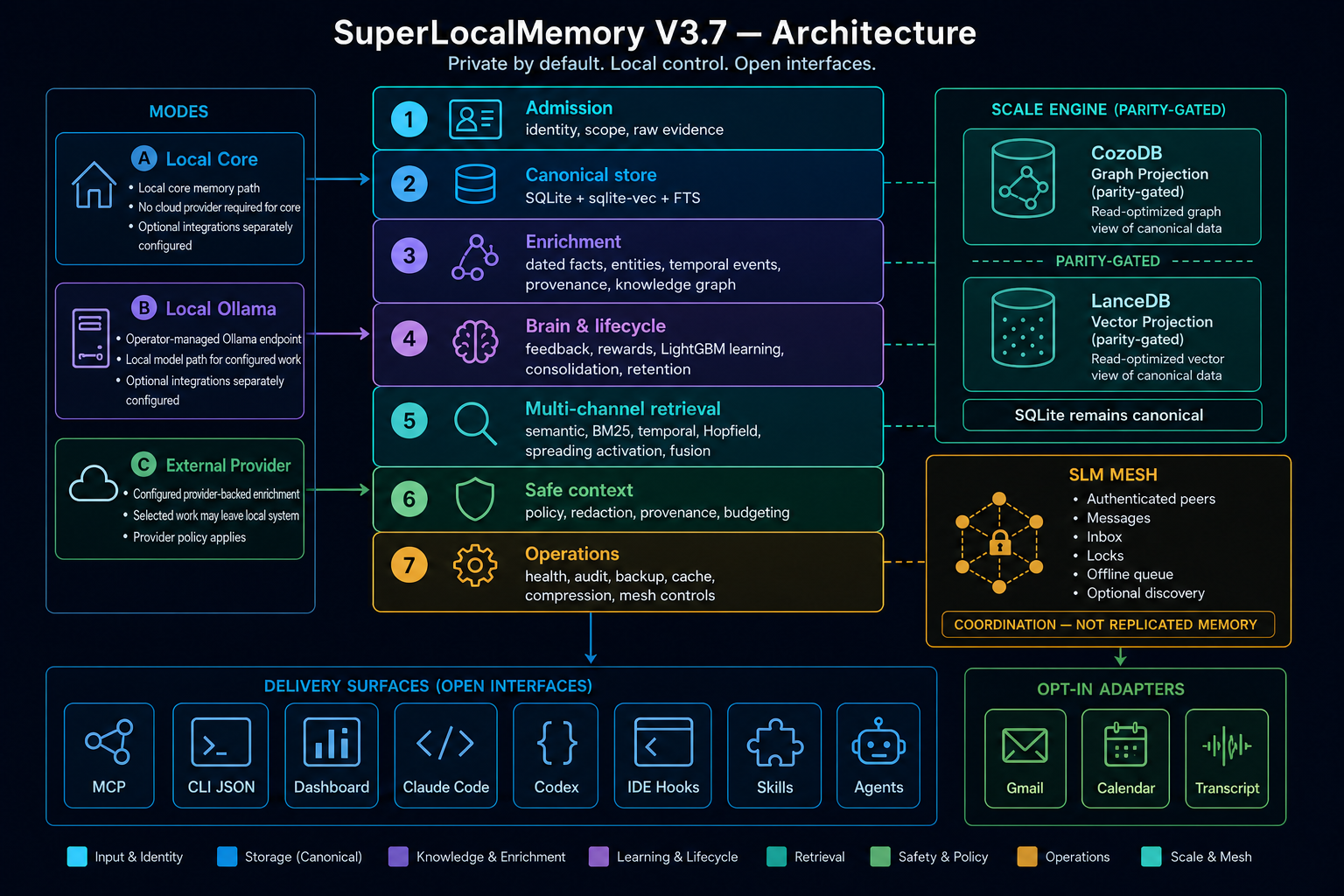
*Architecture boundary: SQLite + sqlite-vec remain canonical; CozoDB and
LanceDB are parity-gated projections; SLM-Mesh coordinates trusted peers rather
than replicating a distributed memory database; connectors are opt-in.*
Memory boundaries: profiles isolate workspaces by default. Every memory is
`personal`, `shared` with named profile readers, or `global`; cross-profile
recall is default-deny and must be explicitly enabled. This scoped sharing is
local authorization, not SLM-Mesh synchronization. See
IDEs, agents, scripts, connectors, and humans
             │  CLI · MCP (HTTP/stdio) · hooks · dashboard
             ▼
 ┌────────────────────────── SLM CONTROL PLANE ──────────────────────────┐
 │  1. Admission       identity, scope, idempotency, raw evidence         │
 │  2. Queryable core  SQLite facts + FTS durable receipt                  │
 │  3. Enrichment      facts, entities, scenes, time, provenance, graph   │
 │  4. Memory brain    feedback, patterns, rewards, consolidation          │
 │  5. Retrieval       semantic · BM25 · temporal · Hopfield · activation │
 │  6. Context safety  policy, trust, provenance, redaction, budgets      │
 │  7. Operations      lifecycle, audit, cache/compress, mesh, backups    │
 └───────────────────────────────────────────────────────────────────────┘
             │
             ▼
 SQLite + sqlite-vec canonical store  ──► optional graph/vector projections
The seven stages are an execution model, not a promise that every optional
enricher or retrieval channel runs for every request. The receipt, trace, and
health surfaces expose the stages actually completed by the installed runtime.
| Capability | What ships today | Operator boundary |
|---|---|---|
| Memory types and lifecycle | Atomic facts, episodic scenes, temporal events, canonical entities, profiles/scopes, consolidation, forgetting and retention controls | Lifecycle policies and retention decisions remain operator-configured. |
| Memory boundaries | Profile-isolated workspaces plus `personal`, `shared`, and `global` memory scopes | Personal is the default; shared/global recall requires explicit scope policy or per-call opt-in. |
| Ingestion | Durable raw-to-complete operation state, fact extraction, entity resolution, graph/temporal/provenance derivations, and replay-safe identity | `--sync` waits for declared stages; dependencies and mode determine which enrichers are available. |
| Retrieval and recall | Semantic, lexical, temporal, Hopfield and spreading-activation candidate channels; RRF fusion, optional reranking and graph score enhancement | Healthy channels participate; response provenance states the evidence used. |
| Brain and learning | Behavioral patterns, feedback/outcome records, rewards, consolidation, LightGBM-related ranking components, soft prompts, and guarded skill-evolution workflows | Learning is evidence-driven; it does not claim autonomous correctness or guaranteed improvement. |
| Knowledge graph and entities | Canonical entities, aliases, entity profiles, graph edges, scenes, timelines, explorer and graph APIs | Stored/derived graph data is evidence, not an instruction authority. |
| Scale Engine | SQLite + sqlite-vec are canonical. CozoDB graph and LanceDB vector projections are managed with prepare → verify → promote → rollback; a structurally detected pre-v3.7 projection can be explicitly adopted. | Promotion is parity-gated and crash-recoverable. Legacy adoption preserves the prior projection as a rollback backup; repeated physical edge rows normalize to one logical edge with the strongest weight. |
| Optimize | Exact cache, tagged invalidation, safe compression, opt-in aggressive prose compression, CCR originals, proxy/MCP/skill surfaces | Only proxy intercepts a primary provider turn. MCP/skill cache results explicitly routed through SLM. |
| SLM-Mesh | Authenticated peer messages, inbox/outbox, locks, offline queue, optional discovery and mesh MCP tools | SLM-Mesh is coordination, not automatic replicated memory or conflict resolution. |
| Governance and operations | Provenance, audit/retention/policy surfaces, export/erasure controls, diagnostics, health, backups and daemon lifecycle | These are engineering controls, not a legal certification. |
| Integrations | CLI, Python SDK, MCP HTTP/stdio, Claude plugin, Codex add-on, supported IDE configurations, Gmail/Calendar/transcript adapters | Hooks, IDE edits, connectors, and networked adapters require explicit operator activation. |
What the dashboard exposes
`slm dashboard` opens a local operational view of the same control plane:
| Workspace | Use it to inspect or control |
|---|---|
| Dashboard and Health | daemon identity, storage/runtime health, diagnostics and recent activity |
| Brain | consolidation, behavioral patterns, outcomes/rewards, learning state and soft prompts |
| Knowledge Graph and Memories | graph neighborhoods, entities, scenes, temporal evidence, memory inspection and mutation |
| Operations | ingestion-operation state, traces, maintenance and lifecycle work |
| Entity Explorer and Skill Evolution | compiled entity summaries/timelines; opt-in skill lineage, budgets and verification outcomes |
| Multi-Agent Memory | per-agent write activity and attribution; memories stamped by `SLM_AGENT_ID`, agent write counts, and trust signals |
| SLM-Mesh Peers | configured peers, inbox/outbox, pending coordination and locks |
| Settings and Optimize | mode/provider/configuration; cache, compression and savings telemetry |
Dashboard visibility is not a substitute for runtime proof: use `slm doctor`,
`slm health`, `slm trace`, and the relevant CLI/MCP operation to validate a
deployment.
Watch the product walkthrough
**Watch the SuperLocalMemory demo on YouTube** — a five-minute walkthrough of installation, setup, recall, cache, and compression. The video shows a product walkthrough; use the commands and release notes in this README as the current release contract.
Published LoCoMo evidence (V3 architecture, carried into V4)
The V3 paper evaluates the multi-channel architecture that V4 still runs. Every figure below
is protocol-scoped, so a reader can distinguish local retrieval, answer
construction, and cloud-assisted evaluation rather than treating unlike runs as
one score.
| Published configuration | LoCoMo aggregate | Protocol scope | What the result establishes |
|---|---|---|---|
| Mode A Raw | 60.4% | 10 conversations; 1,276 scored questions; local embeddings, local retrieval, and zero-LLM answer construction | End-to-end local answer construction under the published V3 protocol. |
| Mode A Retrieval | 74.8% | 10 conversations; 1,276 scored questions; local retrieval, then GPT-4.1-mini answer synthesis | Retrieval evidence: local retrieval contributes the evidence, while the disclosed external model constructs the final answer. |
| Mode C | 87.7% | Conv-30 only; 81 scored questions; text-embedding-3-large plus GPT-4.1-mini answer generation and judge | Cloud-assisted configuration on one fully disclosed conversation; not a full-dataset result. |
Published category results: Mode A Retrieval scored 72.0% single-hop,
70.3% multi-hop, 80.0% temporal, and 85.0% open-domain. Mode C
scored 64.0% single-hop, 100.0% multi-hop, and 86.0% open-domain
on its 81-question Conv-30 scope (no temporal category was reported for that
run). Across six LoCoMo conversations, the paper reports 71.7% with the
information-geometric layers versus 58.9% without them: +12.7pp.
See arXiv:2603.14588 and the [official
LoCoMo paper](https://arxiv.org/abs/2402.17753) for the full protocol,
ablation table, and limitations. These are published V3 architecture results
carried into V4—not a substitute for a newly rerun release-artifact benchmark.
Quick Start
# Primary path 1 — npm global CLI (Node 18+)
# Creates a package-owned virtual environment. It does not modify system Python.
npm install -g superlocalmemory
slm setup       # Choose mode (A/B/C)
slm doctor # Verify everything is working# Primary path 2 — Python CLI + SDK in an activated virtual environment
python3 -m venv .venv
source .venv/bin/activate # Windows PowerShell: .venv\Scripts\Activate.ps1
python -m pip install superlocalmemory
slm setup
slm doctor# First use
slm remember "Alice works at Google as a Staff Engineer" --json
slm recall "What does Alice do?"
slm statusThe default daemon write commits raw evidence plus a relational/FTS projection
and returns a durable receipt in `queryable` state. Enrichment then advances the
same operation through `enriching` to `complete`, or records a retryable
`failed` state. Use `slm remember "..." --sync` when the caller must wait for
all declared derivation and projector stages. JSON output includes the opaque
`operation_id`, current `materialization_state`, and fact IDs.
# Wrap your agent — starts proxy + sets environment + launches agent
slm wrap claude
# Your first repeat prompt → CACHE HIT → $0.00
# See savings: slm optimize savings --since 1
Upgrading: use the owner of the installation: `npm update -g superlocalmemory`
or, while the Python virtual environment is active,
`python -m pip install --upgrade superlocalmemory`. Then run
`slm restart && slm doctor`. Repository-clone users use the matching `upgrade`
action in `scripts/install.sh` or `scripts/install.ps1`. Installers never move
or delete memory data.
Three Pillars
Memory
Current recall has five candidate producers—dense semantic, BM25 lexical,
temporal, Hopfield associative, and spreading activation—followed by fusion,
optional reranking, and entity-graph score enhancement. The entity graph does
not create an independent candidate in the current implementation. Core memory
is SQLite-backed. SQLite and sqlite-vec remain the canonical source of truth.
The packaged Scale Engine can maintain CozoDB graph and LanceDB vector
projections, and it remains outside active retrieval paths until a staged
parity witness proves it matches the canonical store. New installations remain
on Local Core. During upgrade, `slm db scale status` can identify a positive
pre-v3.7 layout candidate; the operator confirms it with `slm db scale adopt`.
SLM then rebuilds from canonical SQLite, verifies it, and promotes it with a
durable recovery journal while retaining the prior directories as a rollback
backup. `adopt` reports `restart_required: true`; run `slm restart` before
checking daemon health. If proof fails, recall remains on SQLite and status
retains the rejected manifest for inspection, retires its replaceable derived
payload, and allows a corrected retry.
Canonical ingestion is a durable state machine: `raw → queryable → enriching →
complete`, with `failed` retaining raw evidence, error details, attempt count,
and retry timing. SQLite relational facts and FTS are the queryable checkpoint;
optional ANN/vector projectors are verified before `complete` is granted.
Recalled text is treated as untrusted evidence. Hooks, MCP `session_init`, CLI
session context, and chat use one bounded renderer that redacts recognized
secrets, neutralizes forged boundary markers, and attaches provenance. Trusted
IDE instruction files contain only the static SLM protocol; fresh memory is
retrieved at runtime rather than copied into those files.
Score Contract v2: `relevance_score` is query-relative relevance;
`ranking_score` is internal ranking utility; `memory_confidence` belongs to the
stored assertion; and `trust_score` is an evidence-policy signal. Legacy
`score` and `confidence` remain aliases for one compatibility release. It is
explicitly uncalibrated: `calibration_status` is `uncalibrated` and
`answer_confidence` is `null`. See
The retrieval/lifecycle implementation includes three mathematical layers that
can run without a cloud LLM:
1. Fisher-informed scoring — dense candidate generation uses cosine similarity; Fisher-derived terms can modify later scoring when their state is available.
2. Sheaf Cohomology for Consistency — algebraic topology detects contradictions via coboundary norms on the knowledge graph.
3. Riemannian Langevin Lifecycle — memory positions evolve continuously on the Poincare ball, and where a memory sits decides its lifecycle stage. There is no retention timer counting down against a memory: what moves it outward is being left alone, and what pulls it back is being used. The stage boundaries themselves are fixed radii.
Auto-capture hooks are installed explicitly with `slm hooks install` (Claude
Code) or `slm hooks install --agent codex` (Codex). Hook latency and capture
quality must be evaluated for the target client and workload; SLM publishes no universal p99 claim.
Multi-scope memory (opt-in): keep memories `personal` (default), `shared` with named profiles, or `global` across the machine. Off by default — recall only ever returns your own facts until you turn sharing on, per call or in config. See **docs/shared-memory.md**.
Multilingual models: configure an OpenAI-compatible embedding endpoint such as Ollama, vLLM, LiteLLM, `bge-m3`, `multilingual-e5`, or `Qwen3-Embedding`. Language coverage and retrieval quality depend on the selected model and should be evaluated for the deployment corpus.
Cache + Compress
One engine, three ways in — choose the surface that fits your setup:
| Surface | How you use it | Requires proxy? | Window effect | Cache scope |
|---|---|---|---|---|
| A — Proxy | `slm wrap claude` or `ANTHROPIC_BASE_URL=http://127.0.0.1:8765` | Yes | Shrinks | Full-turn cache — every call |
| B — MCP tools | Add 5 tools to MCP config; call `slm_compress`, `slm_cache_set/get` | No | Preserved (1M) | Results you explicitly route through SLM |
| C — Skill | Copy `skills/slm-optimize/SKILL.md` → `~/.claude/skills/` | No | Preserved (1M) | Auto-applied by the agent per skill rules |
The hard constraint: The primary Claude conversation turn cannot be cached without a proxy. The MCP/skill path caches results you explicitly route through SLM (tool outputs, file reads, sub-model calls) — without a proxy the main conversation turn is not intercepted.
How to choose:
- Metered API (pay-per-token), want every call cached → Proxy (A)
- Pro/Max/Team subscription or any plan where you won't run a proxy → MCP tools (B) or Skill (C)
- Zero configuration → Skill (C): install once, auto-compresses CLAUDE.md and large outputs
- Agent-controlled caching of repeated file reads → MCP tools (B)
Cache: exact-match SQLite lookup is the stable cache path. Semantic cache
controls are experimental until release-linked precision, invalidation, and
tenant-isolation evidence exists. A cache hit can avoid a provider request, but
actual cost and latency savings depend on the intercepted surface and provider.
Compress: safe mode uses conservative normalization and preserves JSON and code; measured reduction varies by content and can be zero. Aggressive prose compression is opt-in and lossy. CCR can retain an original for later byte-exact retrieval when reversible storage is enabled.
Savings dashboard: `slm optimize savings --since 7` — live USD/INR/tokens saved. Hot-reload config, fail-open.
SLM-Mesh (cross-session / cross-machine coordination)
SLM-Mesh is the V4 peer-coordination plane: authenticated messages, locks, shared lightweight state, inbox/outbox, and an offline queue between configured peers (same machine sessions or cross-machine). Optional mDNS discovery (`SLM_MESH_DISCOVERY=on`). It is not a replicated or conflict-resolving distributed-memory database — multi-scope memory sharing is a separate local-authorization feature.
# Machine A (broker)
export SLM_MESH_HOST=192.168.1.100
export SLM_MESH_SHARED_SECRET=my-secret-key
slm init

# Machine B (client)
export SLM_MESH_PEER_URL=http://192.168.1.100:8765
export SLM_MESH_SHARED_SECRET=my-secret-key
slm init
Eight SLM-Mesh MCP tools: `mesh_summary`, `mesh_peers`, `mesh_send`, `mesh_inbox`, `mesh_state`, `mesh_lock`, `mesh_events`, `mesh_status`.
Full docs: docs/multi-machine.md · docs/distributed-deployment.md
Install Paths
> V4 platform support: Apple Silicon macOS, 64-bit Windows, and 64-bit Linux. Intel Mac and 32-bit Windows are not supported by the patched `cryptography` 50 runtime.
| Path | Command | When |
|---|---|---|
| npm global CLI (primary) | `npm install -g superlocalmemory` | Node 18+; package-owned virtual environment; system Python is not modified; run `slm setup` explicitly afterward |
| Python CLI + SDK (primary) | Activate a Python virtual environment, then `python -m pip install superlocalmemory` | Python 3.11+; the `slm` CLI and importable SDK stay inside that environment |
| Repository clone — macOS/Linux | `./scripts/install.sh install` | Research/contributor path; delegates to an existing uv or pipx installation |
| Repository clone — Windows | `.\scripts\install.ps1 -Action Install` | Research/contributor path; delegates to an existing uv or pipx installation |
| Claude Code Plugin | `/plugin marketplace add qualixar/superlocalmemory` then `/plugin install superlocalmemory@qualixar` | Self-bootstraps venv, isolated SLM_DATA_DIR, additive — 34-tool code profile. Ships the skills/agents/hooks/commands |
| Portable / IDE connect | `slm connect [--here]` | Wire any IDE without reinstalling; `slm connect claude-code` → plugin pointer |
After any install path: `slm setup` → `slm doctor` → `slm warmup` (optional, pre-downloads ~500MB embedding model).
Upgrading an existing installation
An npm, pip, or repository update upgrades the SLM runtime; it does not silently
rewrite your IDE configuration, hooks, or plugin state. Review the existing
integrations first:
slm upgrade-hostsThen explicitly apply the hosts you approve, for example
`slm upgrade-hosts --host codex --apply`, or use
`slm upgrade-hosts --all-detected --apply` after reviewing the preview. See
Host Integration Upgrades for the full safety contract
and the Claude Code plugin update path.
| Component | Size | When |
|---|---|---|
| Core libraries (numpy, scipy, networkx) | ~50MB | During install |
| Dashboard & MCP server (fastapi, uvicorn) | ~20MB | During install |
| Learning engine (lightgbm) | ~10MB | During install |
| Search engine (sentence-transformers, torch) | ~200MB | During install |
| Embedding model (nomic-embed-text-v1.5, 768d) | ~500MB | First use or `slm warmup` |
| Mode B requires Ollama + a model (`ollama pull llama3.2`) | ~2GB | Manual |
MCP + Profiles
SLM supports two MCP transports:
HTTP (recommended):
{ "mcpServers": { "superlocalmemory": { "type": "http", "url": "http://127.0.0.1:8765/mcp/" } } }Or: `claude mcp add --transport http superlocalmemory http://127.0.0.1:8765/mcp/`
stdio (universal fallback):
{ "mcpServers": { "superlocalmemory": { "command": "slm", "args": ["mcp"] } } }MCP Profiles
Control tool surface via `SLM_MCP_PROFILE`:
| Profile | Tools | Use case |
|---|---|---|
| `core` | 16 | Memory, session, optimize, and correction review |
| `code` | 31 | Core + portable Brain evidence + code-graph tools + profile switching + bounded loops |
| `mesh` | 8 | SLM-Mesh only — multi-session / multi-machine coordination |
| `full` | 49 | Memory + portable Brain evidence + optimize + evolution + mesh + bounded loops |
| `power` | 61 | Full + administration, lifecycle, and diagnostics |
| `whole` | 94 | Every registered MCP tool |
Precedence: `ALL` > `TOOLS` > `PROFILE` > `default`
export SLM_MCP_PROFILE=full   # or core / code / mesh / power / whole
slm mcp
For a predictable small surface, set `core` explicitly. Leaving the variable
unset retains the compatibility default, whose mesh tools follow the local
mesh setting. Count-suffixed aliases remain for backward compatibility and emit a migration warning: `core14`, `core16`, `code20`, `code21`, `code24`, `code28`, `code29`, `code31`, `mesh8`, `full38`, `full39`, `full42`, `full46`, `full47`, `full49`, `power50`, `power51`, `power54`, `power58`, `power59`, `power61`, `whole81`, `whole84`, `whole91`, `whole92`, `whole94`. Unknown names stop startup instead of silently selecting another tool set.
Per-IDE configs available for Claude Code, Cursor, Windsurf, VS Code Copilot, Continue, Gemini CLI, JetBrains, Zed, and more (15 configs in `ide/configs/`). See docs/ide-setup.md.
Editor plugins
The plugin is how most people should install SLM. It brings the MCP server, the
skills, the sub-agents, the slash commands and the hooks in one step, and keeps
them at the same version as the package.
Five surfaces, one source. Everything below is generated from `plugin-src/`,
so no surface can quietly fall behind another:
| Editor | Install | Skills | Agents | Commands | Hooks |
|---|---|---|---|---|---|
| Claude Code | `claude plugin marketplace add qualixar/superlocalmemory` then `claude plugin install superlocalmemory@qualixar` | 12 | 4 | 1 | yes |
| Codex | copy `codex-plugin/` into your Codex plugins directory | 12 | 4 | 1 | yes |
| VS Code / Copilot | copy `copilot-plugin/.github/` into your repository | 12 | 4 | as prompts | yes |
| Antigravity | copy `antigravity-plugin/` into your plugins directory | 12 | 4 | 1 | yes |
| Hermes | install the native plugin from the immutable release commit | 12 | 4 | all SLM commands | yes |
What you get
- Skills — `slm-remember`, `slm-recall`, `slm-session`, `slm-graph`,
`slm-mesh`, `slm-scope`, `slm-profile`, `slm-governance`, `slm-cache`,
`slm-compress`, `slm-status`, `slm-loop`.
- Sub-agents — a memory advisor, a governance advisor, a context-optimization
advisor, and a loop runner, each scoped to the tools it actually needs.
- Commands — `/slm-loop`, to run a task as a gate-verified bounded loop.
- Hooks — session start and end, so context loads and commits without being
asked.
Hermes
Hermes users get the same SLM skills and advisor roles through a native
`plugin.yaml` package, plus `/slm ` and generated `/slm-`
aliases for the public CLI surface. The plugin is intentionally separate from
the PyPI/npm runtime: install the owning SLM runtime first, then install the
reviewed pinned pack from the `v4.1.13` GitHub release. It is additive and does
not replace Hermes's selected memory provider or existing configuration. See
Keeping it current
`pipx upgrade superlocalmemory` upgrades the package. It does not
upgrade the plugin — those are separate channels, and the plugin is delivered by
your editor. `slm doctor` reports both versions side by side and names the
command that updates the one that is behind.
claude plugin marketplace update qualixar
claude plugin update superlocalmemory@qualixar
For the other three, replace the directory from the tag you are on.
Privacy controls and operating modes
| Mode | What | Core memory path | Optional network behavior |
|---|---|---|---|
| A | Local Guardian | Local processing | Model/dependency downloads, connectors, backup, and other enabled integrations may use the network |
| B | Smart Local | Local Ollama enrichment | Same optional integrations as Mode A |
| C | Provider-assisted | Local storage with provider calls | Query or enrichment content is sent to the configured provider |
slm mode a   # Zero-cloud (default)
slm mode b   # Local Ollama
slm mode c   # Cloud LLM
Mode A can run core memory operations without sending memory content to a cloud model provider. This does not disable optional connectors, cloud backup, proxy providers, dependency acquisition, or model downloads; review configuration and network policy for the deployment.
SuperLocalMemory provides local storage, export/erasure commands, provenance, policy, and audit features that can support a compliance program. The software is not a legal certification, and compliance depends on the use case, operator, configuration, and surrounding systems.
Available controls include local export and erasure commands, hash-chained audit records, provenance tracking, and ABAC policy enforcement. Verify their behavior and retention boundaries for your deployment; see docs/compliance.md.
Teams and Enterprise Memory (V4)
V4 includes multi-user, multi-workspace controls for teams and organizations (introduced on the 3.8 line and retained). These are opt-in — personal single-user installs work exactly as before with no required login.
Users and roles
SLM supports three role tiers within a workspace: admin, member, and viewer.
| Role | Can read memory | Can write memory | Can manage users/config |
|---|---|---|---|
| admin | yes | yes | yes |
| member | yes | yes | no |
| viewer | yes | no | no |
Roles are scoped per workspace (profile). A user may have different roles in different workspaces.
Workspace isolation
Each workspace (profile) is a fully isolated memory namespace. One workspace cannot read another's personal memories. Shared and global scopes are opt-in and still profile-bounded at the authorization layer.
Login gate
Enterprise deployments set `require_login = true` in configuration. With login enabled:
- Every dashboard and API request requires an authenticated session.
- First-run creates an admin account with a user-chosen password (no default credentials are shipped).
- Session cookies use `HttpOnly` with optional `Secure` enforcement.
- Personal installs run with `require_login = false` (loopback owner is trusted).
slm config set security.require_login true # Enable for team/enterprise useMemory scopes
| Scope | Who can recall | Set with |
|---|---|---|
| `personal` | Owner profile only (default) | `slm remember "..." --scope personal` |
| `shared` | Named profiles the owner grants | `slm remember "..." --scope shared --shared-with profile-a,profile-b` |
| `global` | Any authorized user on this machine | `slm remember "..." --scope global` |
Recall is default-deny: shared and global facts are never returned unless the caller explicitly opts in (`--include-shared`, `--include-global`) or the scope policy allows it. See docs/shared-memory.md.
GDPR and data governance
SLM ships built-in controls that support GDPR compliance programs:
- Export — full profile data export as a structured JSONL bundle
- Erasure — profile deletion removes data from 30+ scoped tables; erasure is logged to the tamper-proof audit chain before any data is deleted
- Retention rules — time-based policies (`indefinite`, `gdpr-30d`, `hipaa-7y`, `custom`) applied per profile
- Audit trail — every store, recall, mutation, and erasure produces a hash-chained audit record
- PII redaction — configurable automatic redaction before memory content crosses trust boundaries
These are engineering controls. Compliance depends on deployment configuration, use case, and operator responsibility. See docs/compliance.md.
EU AI Act mode verification
SLM includes a per-mode EU AI Act *technical posture* report (`EUAIActChecker`). It records facts the runtime can know — whether data is configured to stay local, whether generative AI is used, and that transparency / human-oversight need deployment evidence.
An operating mode does not establish legal compliance under the EU AI Act. Legal risk classification and conformity assessment depend on intended purpose, affected persons, sector, deployment context, and operator controls. The checker therefore returns `compliant=None` / risk category `undetermined` for every mode and always requires deployment-context review. Mode A/B/C only change technical locality and enrichment options (for example Mode C may send content to a configured provider). See docs/compliance.md and `src/superlocalmemory/core/modes.py`.
Deployment tiers
SLM ships one binary and is configured for the appropriate tier at install or post-install time.
| Tier | Login gate | PII redaction | Retention | Audit |
|---|---|---|---|---|
| Personal | off | off | off | on |
| Enterprise | on | on | on | on |
The installer or `slm reconfigure` sets the tier. Each setting is independently overridable at runtime. Full tier documentation: docs/deployment-tiers.md.
RBAC and teams docs
Full reference: docs/rbac-teams.md · docs/deployment-tiers.md
Bounded Loops (V4)
A bounded loop terminates only when an independent gate passes — a test
suite exit code, a linter, a JSON-schema check, or an SLM-recall condition.
The agent's own "I finished" message is recorded as advisory context and never
used as the termination signal. Every lap is persisted to SLM memory under the
tag `loop:`, so runs are auditable and resumable across sessions.
Three surfaces ship together:
| Surface | How you use it |
|---|---|
| CLI | `slm loop demo` · `slm loop history [--name ]` · `slm loop show ` |
| Skill + agent | `/slm-loop` skill with the `slm-loop-runner` agent — delegate a task that has a checkable acceptance condition |
| MCP tools | `slm_loop_run` · `slm_loop_history` · `slm_loop_show` — call from any IDE or agent (available in the `code` and `full` MCP profiles) |
# Run the built-in convergence demo (no API key needed)
slm loop demo

# Inspect recorded runs
slm loop history --name convergence-demo
slm loop show
Loop laps are stored as ordinary SLM memories and are visible in the dashboard
under Knowledge Graph and Memories (filter by tag `loop:`) and in the
Multi-Agent Memory workspace.
Framework Adapters (V4)
SLM ships nine adapters under `ide/integrations/`: LangGraph, Semantic Kernel,
Microsoft Agent Framework, LangChain, LlamaIndex, CrewAI, AutoGen, Google ADK,
and OpenAI Agents. Each wires SLM as memory and history without replacing the
framework runtime; its directory contains installation/configuration guidance.
Pydantic AI is not included because it does not expose a formal external-memory
interface.
Advanced
| Topic | Link |
|---|---|
| Full optimize docs | docs/optimize-overview.md · docs/optimize-cli.md · docs/optimize-config.md |
| Distributed deployment | docs/distributed-deployment.md |
| Multi-machine mesh | docs/multi-machine.md |
| Auto-memory hooks | docs/auto-memory.md |
| Architecture + math | docs/ARCHITECTURE.md |
| Published benchmark evidence | docs/benchmarks.md |
| CLI reference | docs/cli-reference.md |
| MCP tools reference | docs/mcp-tools.md |
| Optional Bounded Loops bridge | docs/bounded-loops-bridge.md |
| Getting started | docs/getting-started.md |
| IDE setup (15 configs) | docs/ide-setup.md |
| Teams, users, and RBAC | docs/rbac-teams.md |
| Deployment tiers | docs/deployment-tiers.md |
| pi.dev integration | docs/pi-dev-integration.md |
| Skill evolution | docs/skill-evolution.md |
| V2 migration | docs/migration-from-v2.md |
| Configuration | docs/configuration.md |
| Retrieval score contract | docs/retrieval-score-contract.md |
| Wiki | github.com/qualixar/superlocalmemory/wiki |
Open the web dashboard with `slm dashboard`; workspaces appear only when their
runtime capability is enabled and healthy. See CHANGELOG.md for
the complete release history.
Research Papers
SuperLocalMemory has a V4 arXiv preprint with Zenodo archive and DOI, plus The Living Brain (V3.3), Information-Geometric Foundations (V3), and Trust & Behavioral Foundations (V2).
Use the citation metadata on the linked arXiv or Zenodo records.
Support / License / Qualixar
See CONTRIBUTING.md, the Wiki, and LICENSE (AGPL-3.0). For commercial licensing, see COMMERCIAL-LICENSE.md or contact varun.pratap.bhardwaj@gmail.com.
Copyright (c) 2026 Varun Pratap Bhardwaj / Qualixar · Qualixar · research archive. Acknowledgments: Everything Claude Code informed skill observation; HKUDS/OpenSpace informed skill-evolution verification.
Star This Project
If this project solves a real problem for you, please star the repo — it helps other developers discover Qualixar and signals that the AI agent reliability community is growing.

Frequently asked questions
What is superlocalmemory?
superlocalmemory is Open-source governed, local-first memory control plane for AI agents and teams. arXiv:2608.08253
How do I install superlocalmemory?
Open the GitHub repository and follow its README. Most MCP servers are added to your client's MCP config, then called by your agent.
Is superlocalmemory open source?
Yes — it is hosted on GitHub at https://github.com/qualixar/superlocalmemory and has 224 stars.
Related MCP tools
 projectmem
Open-source coding agent memory. Records issues, attempts, fixes and decisions, then warns your agent before it repeats an approach that already failed. Native MCP server for Claude Code, Cursor, Antigravity and Codex. 100% local, no cloud, no telemetry. MIT.
 memora
Give your AI agents persistent, collective memory — with deduplicating absorb, supersession lineage, semantic search, and a graph UI. Speaks MCP.
 memorix
Open-source cross-agent memory layer for coding agents via MCP. Compatible with Claude Code, Codex, Cursor, Windsurf, Gemini CLI, Antigravity, OpenClaw, Hermes Agent, Oh-my-Pi, Pi, Copilot, Kiro, OpenCode, and Trae.
 jcodemunch-mcp
Cut AI token costs 95%+ on code exploration. The leading MCP server for precise, symbol-level GitHub code retrieval via tree-sitter AST. Works with Claude Code, Cursor & any MCP client. 313B+ tokens saved.
 mcp-server-qdrant
An official Qdrant Model Context Protocol (MCP) server implementation Python-based implementation. Trusted by 1000+ developers.
 Unity-MCP
AI Skills, MCP Tools, and CLI for Unity Engine. Full AI develop and test loop. Use cli for quick setup. Efficient token usage, advanced tools. Any C# method may be turned into a tool by a single line. Works with Claude Code, Gemini, Copilot, Cursor and any other absolutely for free.
Run your own MCP server? See who uses it and what to fix.
Measure it with TrackMCP