
mcp-jdbc-server
Java based Model Context Procotol (MCP) Server for JDBC
Documentation
OpenLink MCP Server for JDBC
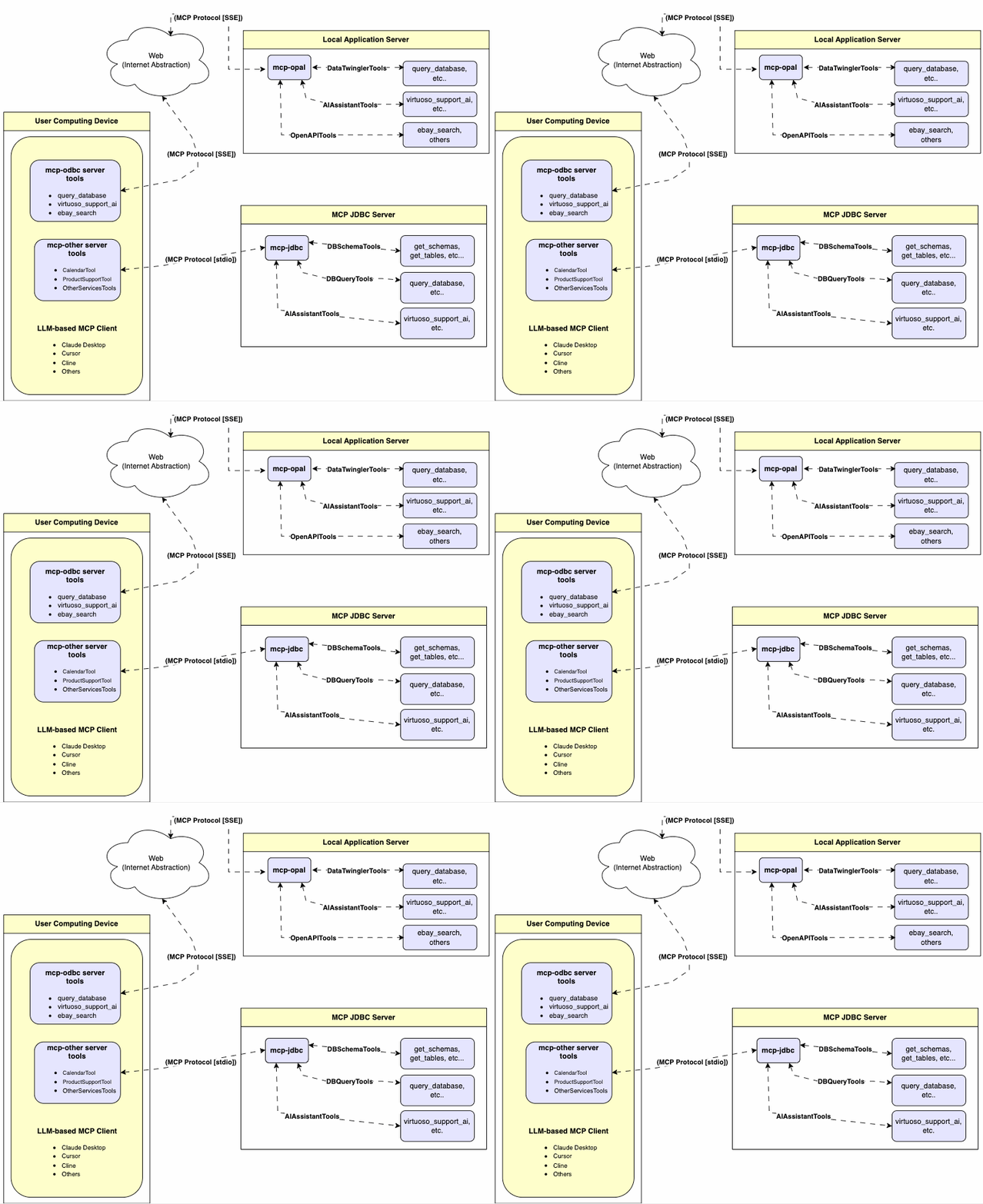
A lightweight Java-based MCP (Model Context Protocol) server for JDBC built with Quakrus.
This server is compatible with Virtuoso DBMS and any other DBMS backend that has a JDBC driver.
Features
- Get Schemas: Fetch and list all schema names from the connected database.
- Get Tables: Retrieve table information for specific schemas or all schemas.
- Describe Table: Generate a detailed description of table structures, including:
- Column names and data types
- Nullable attributes
- Primary and foreign keys
- Search Tables: Filter and retrieve tables based on name substrings.
- Execute Stored Procedures: _A Virtuoso-specific feature!_ Execute stored procedures and retrieve results.
- Execute Queries:
- JSONL result format: Optimized for structured responses.
- Markdown table format: Ideal for reporting and visualization.
Prerequisites
MCP server requires Java 21 or above.
Installation
Clone this repository:
git clone https://github.com/OpenLinkSoftware/mcp-jdbc-server.git
cd mcp-jdbc-server
Environment Variables
Update your `.env` by overriding these defaults to match your preferences:
jdbc.url=jdbc:virtuoso://localhost:1111
jdbc.user=dba
jdbc.password=dba
jdbc.api_key=xxx
Configuration
For Claude Desktop users using Virtuoso and its JDBC driver:
Add the following to `claude_desktop_config.json`:
{
  "mcpServers": {
    "my_database": {
      "command": "java",
      "args": ["-jar", "/path/to/mcp-jdbc-server/MCPServer-1.0.0-runner.jar"],
      "env": {
        "jdbc.url": "jdbc:virtuoso://localhost:1111",
        "jdbc.user": "username",
        "jdbc.password": "password",
        "jdbc.api_key": "sk-xxx"
      }
    }
  }
}
For Claude Desktop users using another JDBC driver or a combination of drivers:
Add the following, edited to suit your local environment, to `claude_desktop_config.json`:
"jdbc": {
      "command": "java",
      "args": [
        "-cp",
        "/path/to/mcp-jdbc-server/MCPServer-1.0.0-runner.jar:/path/to/jdbc_driver1.jar:/path/to/jdbc_driverN.jar",
        "io.quarkus.runner.GeneratedMain"
      ],
      "env": {
        "jdbc.url": "jdbc:virtuoso://localhost:1111",
        "jdbc.user": "dba",
        "jdbc.password": "dba"
      }
    }
Use
Tools Provided
After successful installation, the following tools will be available to MCP client applications.
Overview
| name | description |
|---|---|
| `jdbc_get_schemas` | List database schemas accessible to connected database management system (DBMS). |
| `jdbc_get_tables` | List tables associated with a selected database schema. |
| `jdbc_describe_table` | Provide the description of a table associated with a designated database schema. This includes information about column names, data types, nulls handling, autoincrement, primary key, and foreign keys. |
| `jdbc_filter_table_names` | List tables, based on a substring pattern from the `q` input field, associated with a selected database schema. |
| `jdbc_query_database` | Execute a SQL query and return results in JSONL format. |
| `jdbc_execute_query` | Execute a SQL query and return results in JSONL format. |
| `jdbc_execute_query_md` | Execute a SQL query and return results in Markdown table format. |
| `jdbc_spasql_query` | _A Virtuoso-specific feature!_ Execute a SPASQL query and return results. |
| `jdbc_sparql_query` | _A Virtuoso-specific feature!_ Execute a SPARQL query and return results. |
| `jdbc_virtuoso_support_ai` | _A Virtuoso-specific feature!_ Interact with LLMs through the Virtuoso Support Assistant/Agent. |
Detailed Description
- `jdbc_get_schemas`
- Retrieve and return a list of all schema names from the connected database.
- Input parameters:
- `user` (string, optional): Database username. Defaults to `"demo"`.
- `password` (string, optional): Database password. Defaults to `"demo"`.
- `url` (string, optional): JDBC URL connection string.
- Returns a JSON string array of schema names.
- `jdbc_get_tables`
- Retrieve and return a list containing information about tables in a specified schema. If no schema is provided, uses the connection's default schema.
- Input parameters:
- `schema` (string, optional): Database schema to filter tables. Defaults to connection default.
- `user` (string, optional): Database username. Defaults to `"demo"`.
- `password` (string, optional): Database password. Defaults to `"demo"`.
- `url` (string, optional): JDBC URL connection string.
- Returns a JSON string containing table information (e.g., `TABLE_CAT`, `TABLE_SCHEM`, `TABLE_NAME`, `TABLE_TYPE`).
- `jdbc_filter_table_names`
- Filters and returns information about tables whose names contain a specific substring.
- Input parameters:
- `q` (string, required): The substring to search for within table names.
- `schema` (string, optional): Database schema to filter tables. Defaults to connection default.
- `user` (string, optional): Database username. Defaults to `"demo"`.
- `password` (string, optional): Database password. Defaults to `"demo"`.
- `url` (string, optional): JDBC URL connection string.
- Returns a JSON string containing information for matching tables.
- `jdbc_describe_table`
- Retrieve and return detailed information about the columns of a specific table.
- Input parameters:
- `schema` (string, required): The database schema name containing the table.
- `table` (string, required): The name of the table to describe.
- `user` (string, optional): Database username. Defaults to `"demo"`.
- `password` (string, optional): Database password. Defaults to `"demo"`.
- `url` (string, optional): JDBC URL connection string.
- Returns a JSON string describing the table's columns (e.g., `COLUMN_NAME`, `TYPE_NAME`, `COLUMN_SIZE`, `IS_NULLABLE`).
- `jdbc_query_database`
- Execute a standard SQL query and return the results in JSON format.
- Input parameters:
- `query` (string, required): The SQL query string to execute.
- `user` (string, optional): Database username. Defaults to `"demo"`.
- `password` (string, optional): Database password. Defaults to `"demo"`.
- `url` (string, optional): JDBC URL connection string.
- Returns query results as a JSON string.
- `jdbc_query_database_md`
- Execute a standard SQL query and return the results formatted as a Markdown table.
- Input parameters:
- `query` (string, required): The SQL query string to execute.
- `user` (string, optional): Database username. Defaults to `"demo"`.
- `password` (string, optional): Database password. Defaults to `"demo"`.
- `url` (string, optional): JDBC URL connection string.
- Returns query results as a Markdown table string.
- `jdbc_query_database_jsonl`
- Execute a standard SQL query and return the results in JSON Lines (JSONL) format (one JSON object per line).
- Input parameters:
- `query` (string, required): The SQL query string to execute.
- `user` (string, optional): Database username. Defaults to `"demo"`.
- `password` (string, optional): Database password. Defaults to `"demo"`.
- `url` (string, optional): JDBC URL connection string.
- Returns query results as a JSONL string.
- `jdbc_spasql_query`
- _A Virtuoso-specific feature!_
- Execute a SPASQL (SQL/SPARQL hybrid) query return results.
- Input parameters:
- `query` (string, required): The SPASQL query string.
- `max_rows` (number, optional): Maximum number of rows to return. Defaults to `20`.
- `timeout` (number, optional): Query timeout in milliseconds. Defaults to `30000` (i.e., 30 seconds).
- `user` (string, optional): Database username. Defaults to `"demo"`.
- `password` (string, optional): Database password. Defaults to `"demo"`.
- `url` (string, optional): JDBC URL connection string.
- Returns the result from the underlying stored procedure call (e.g., `Demo.demo.execute_spasql_query`).
- `jdbc_sparql_query`
- _A Virtuoso-specific feature!_
- Execute a SPARQL query and return results.
- Input parameters:
- `query` (string, required): The SPARQL query string.
- `format` (string, optional): Desired result format. Defaults to `'json'`.
- `timeout` (number, optional): Query timeout in milliseconds. Defaults to `30000` (i.e., 30 seconds).
- `user` (string, optional): Database username. Defaults to `"demo"`.
- `password` (string, optional): Database password. Defaults to `"demo"`.
- `url` (string, optional): JDBC URL connection string.
- Returns the result from the underlying function call (e.g., `"UB".dba."sparqlQuery"`).
- `jdbc_virtuoso_support_ai`
- _A Virtuoso-specific feature!_
- Utilizes a Virtuoso-specific AI Assistant function, passing a prompt and optional API key.
- Input parameters:
- `prompt` (string, required): The prompt text for the AI function.
- `api_key` (string, optional): API key for the AI service. Defaults to `"none"`.
- `user` (string, optional): Database username. Defaults to `"demo"`.
- `password` (string, optional): Database password. Defaults to `"demo"`.
- `url` (string, optional): JDBC URL connection string.
- Returns the result from the AI Support Assistant function call (e.g., `DEMO.DBA.OAI_VIRTUOSO_SUPPORT_AI`).
Basic Use & Troubleshooting
MCP Inspector Connecting to Virtuoso's ODBC Driver
For basic MCP client use and troubleshooting, use the MCP Inspector as follows:
1. Install the MCP Inspector:
npm install -g @modelcontextprotocol/inspector2. Start the inspector:
npx @modelcontextprotocol/inspector java -jar /path/to/mcp-jdbc-server/MCPServer-1.0.0-runner.jarAccess the URL returned by the inspector to troubleshoot MCP server interactions.
MCP Inspector Connecting to additional Drivers
For basic MCP client use and troubleshooting, use the MCP Inspector as follows:
1. Install the JDBC Driver(s), ensuring their JAR files are registered with the host operating system's Java Virtual Machine (JVM) via `$CLASSPATH`. For instance:
export CLASSPATH=$CLASSPATH:/path/to/driver1.jar:/path/to/driver2.jar:/path/to/driverN.jar2. Start the inspector using the following command-line arguments:
npx @modelcontextprotocol/inspector java -cp MCPServer-1.0.0-runner.jar:/path/to/driver1.jar:/path/to/driver2.jar:/path/to/driverN.jar io.quarkus.runner.GeneratedMainUse Example based on Oracle and Informix Drivers
0. Assuming the following JDBC Driver information:
jdbc:oracle:thin:@:[port]:jdbc:informix-sqli://:/:=1. Install the Oracle (`ojdbc17.jar`) and/or Informix (`jdbc-15.0.0.1.1.jar`) JDBC Drivers, and ensure their JAR files are registered with the host operating system's Java Virtual Machine (JVM) via `$CLASSPATH`. For instance:
export CLASSPATH=$CLASSPATH:/path/to/Java/Extensions/jdbc-15.0.0.1.1.jar
    export CLASSPATH=$CLASSPATH:/path/to/Java/Extensions/ojdbc17.jar
2. Start the inspector using the following command-line arguments:
npx @modelcontextprotocol/inspector java -cp MCPServer-1.0.0-runner.jar:/path/to/Java/Extensions/ojdbc17.jar:/path/to/Java/Extensions/jdbc-15.0.0.1.1.jar io.quarkus.runner.GeneratedMain3. Access the URL returned by the inspector and then use the `jdbc_execute_query` operation to query the target database, by providing actual values for the following input field templates:
Frequently asked questions
What is mcp-jdbc-server?
mcp-jdbc-server is Java based Model Context Procotol (MCP) Server for JDBC
How do I install mcp-jdbc-server?
Open the GitHub repository and follow its README. Most MCP servers are added to your client's MCP config, then called by your agent.
Is mcp-jdbc-server open source?
Yes — it is hosted on GitHub at https://github.com/OpenLinkSoftware/mcp-jdbc-server and has 8 stars.
Related MCP tools
 java-sdk
The official Java SDK for Model Context Protocol servers and clients. Maintained in collaboration with Spring AI Trusted by 2800+ developers.
 jadx-ai-mcp
Plugin for JADX to integrate MCP server Java-based implementation. Trusted by 600+ developers. Trusted by 600+ developers.
 wren-engine
🤖 The Semantic Engine for Model Context Protocol(MCP) Clients and AI Agents 🔥 Java-based implementation.
 ghidramcp
MCP Server for Ghidra Java-based implementation. Trusted by 6400+ developers. Trusted by 6400+ developers. Trusted by 6400+ developers.
 mcprotocollib
A library for communication with a Minecraft client/server. Built for the Model Context Protocol to enhance AI capabilities. Java-based implementation.
 openhands
🙌 OpenHands: Code Less, Make More for the Model Context Protocol. Enhance AI assistants with powerful integrations. Python-based implementation.
Run your own MCP server? See who uses it and what to fix.
Measure it with TrackMCP