
open-codex-computer-use
👾 Open Computer Use – Open-Source Alternative to Codex Computer Use
Documentation
open-computer-use




> [!TIP]
> Interested in Browser Use? Check out open-browser-use.
`open-computer-use` is an open-source `Computer Use` service wrapped as `MCP`. Any AI agent or MCP client can use it to run Computer Use on macOS, Linux, and Windows.
This project was inspired by OpenAI's Codex Computer Use. It showed that non-intrusive CUA can be built on top of Accessibility, so I decided to build an open-source version.
I started this repo with my harness template, a template for quickly spinning up AI-first projects. It has been one of our most useful workflows lately, especially for nearly 100% AI-generated projects. I also wrote a post about the methodology behind it.
Demos
Codex App and Codex CLI
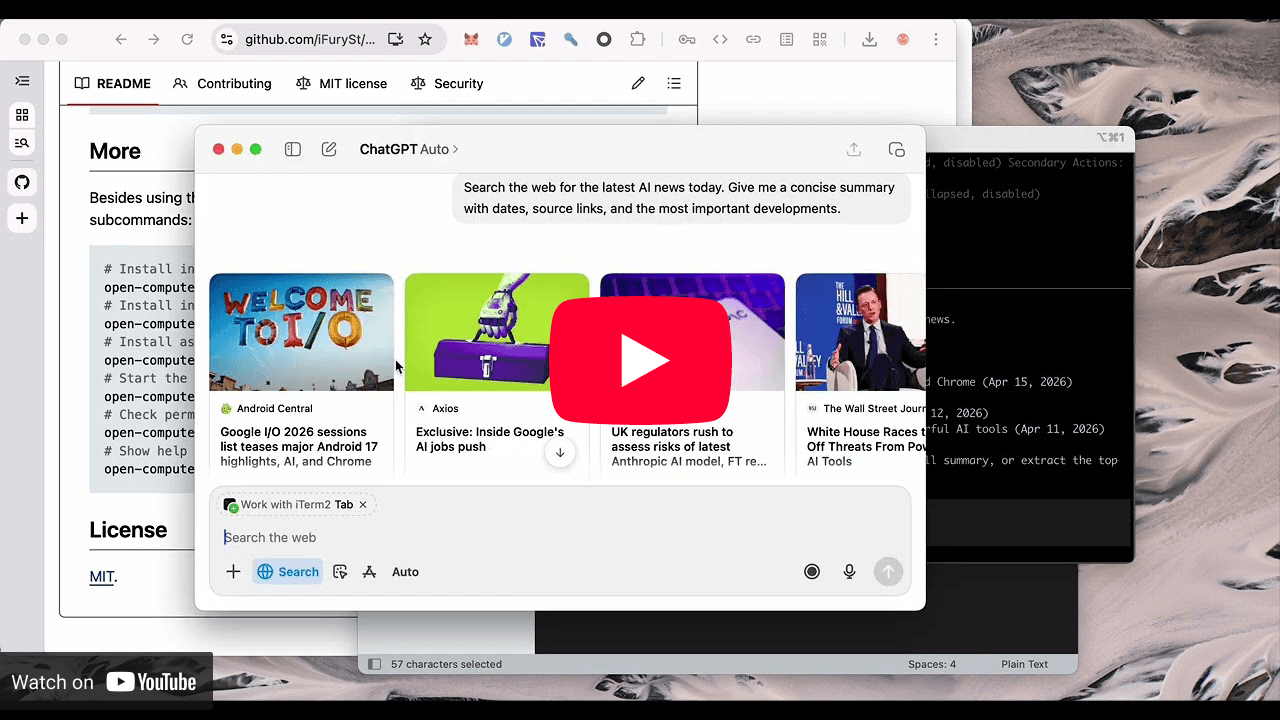
`open-computer-use` used as Computer Use in Codex App and Codex CLI, matching the official experience.
Gemini CLI
https://github.com/user-attachments/assets/eacb3b15-f939-46c7-b3b3-6f876977a58d
Gemini CLI connects to `open-computer-use` through MCP and runs full Computer Use actions.
Linux
https://github.com/user-attachments/assets/e036b1c8-2200-4896-abd4-19225915cf66
`open-computer-use` running on Linux.
Quick Start
npm i -g open-computer-useThe npm package also exposes `ocu` as the short CLI alias.
> [!IMPORTANT]
> The macOS runtime requires macOS 14.0 or later.
On macOS, run it once and grant `Accessibility` and `Screen Recording`. Windows and Linux do not need this step.
open-computer-use
# or
ocu
Before using it, install it into your agent:
# Install into Codex by writing to ~/.codex/config.toml
open-computer-use install-codex-mcp
Or add it to your own client manually:
{
  "mcpServers": {
    "open-computer-use": {
      "command": "open-computer-use",
      "args": ["mcp"]
    }
  }
}
Skill
Install the skill directly:
# Install for Codex
npx skills add iFurySt/open-codex-computer-use -g -a codex --skill open-computer-use -y
npx skills ls -g -a codex | rg 'open-computer-use'
Install for Claude Code:
npx skills add iFurySt/open-codex-computer-use -g -a claude-code --skill open-computer-use -yUpdate an existing global install, including the Codex install created above:
npx skills update open-computer-use -g -yYou can also manually download and install the
More
Besides the MCP JSON config above, you can also use the built-in commands:
# Install into Codex by writing to ~/.codex/config.toml
open-computer-use install-codex-mcp
ocu install-codex-mcp

# Install as a Codex plugin, mainly for Codex App
open-computer-use install-codex-plugin

# Install into Claude Code by writing to ~/.claude.json
open-computer-use install-claude-mcp

# Install into Gemini CLI for the current project by writing to ./.gemini/settings.json
open-computer-use install-gemini-mcp

# Install into Gemini CLI user config instead
open-computer-use install-gemini-mcp --scope user

# Install into opencode by writing to ~/.config/opencode/opencode.json (or the active config file)
open-computer-use install-opencode-mcp

# Call a single Computer Use tool and print the MCP-style JSON result
open-computer-use call list_apps
ocu call list_apps
open-computer-use call get_app_state --args '{"app":"TextEdit"}'

# Run a sequence in one process so element_index state can be reused
# Sequence runs sleep 1s between successful operations by default
open-computer-use call --calls '[{"tool":"get_app_state","args":{"app":"TextEdit"}},{"tool":"press_key","args":{"app":"TextEdit","key":"Return"}}]'
open-computer-use call --calls-file examples/textedit-overlay-seq.json --sleep 0.5

# Check permissions; onboarding only opens when something is missing
open-computer-use doctor

# Run local validation from a source checkout
make smoke
OPEN_COMPUTER_USE_STRESS_LOOPS=20 make stress
make agent-smoke
make agent-smoke SCENARIO=fixture-full
node ./scripts/run-agent-smoke-tests.mjs --agents=claude,codex --command=open-computer-use
node ./scripts/run-agent-smoke-tests.mjs --scenario=fixture --agents=claude,codex --command=open-computer-use
node ./scripts/run-agent-smoke-tests.mjs --scenario=fixture-full --agents=claude,codex --command=open-computer-use
OPEN_COMPUTER_USE_HERMES_PROVIDER=anthropic OPEN_COMPUTER_USE_HERMES_MODEL=claude-opus-4-20250514 make agent-smoke AGENTS=hermes SCENARIO=fixture-full
node ./scripts/run-agent-smoke-tests.mjs --agents=hermes --hermes-provider=anthropic --hermes-model=claude-opus-4-20250514
node ./scripts/run-agent-smoke-tests.mjs --scenario=fixture --agents=hermes --hermes-provider=anthropic --hermes-model=claude-opus-4-20250514
node ./scripts/run-agent-smoke-tests.mjs --scenario=fixture-full --agents=hermes --hermes-provider=anthropic --hermes-model=claude-opus-4-20250514 --hermes-max-turns=12

# Show help
open-computer-use -h
ocu -h
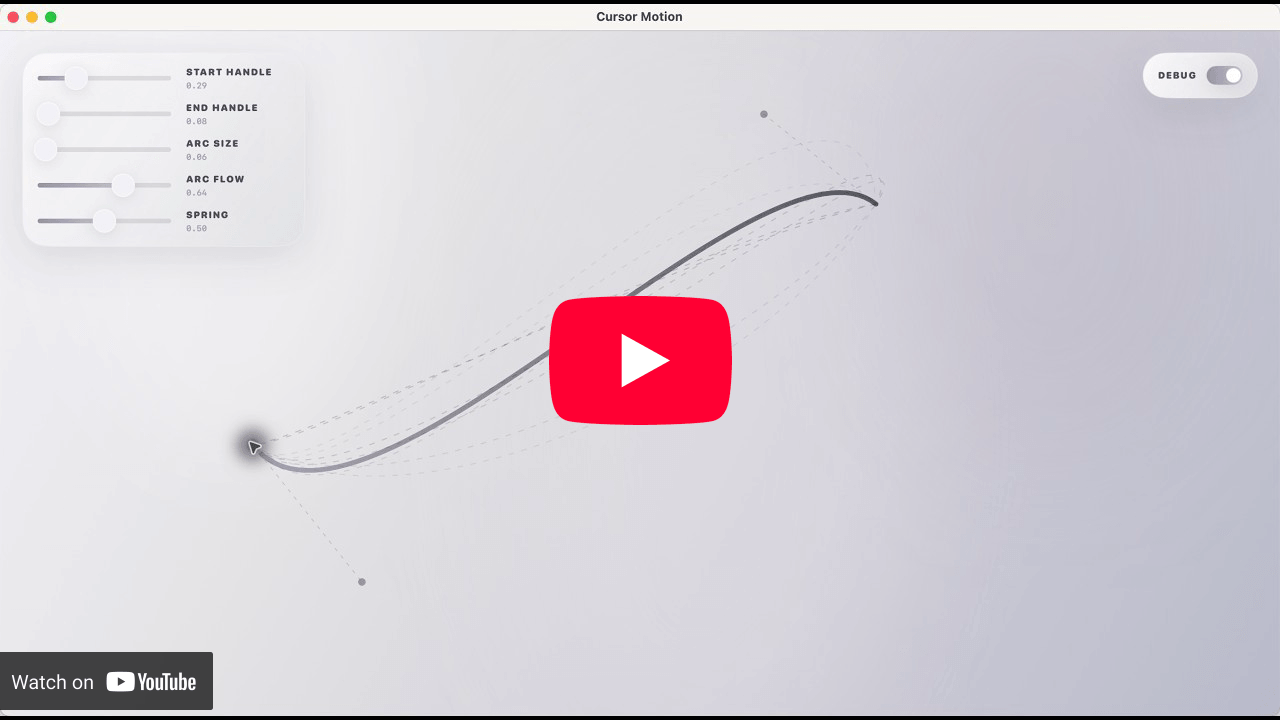
Cursor Motion
Cursor Motion is an open-source cursor motion system for macOS, based on public information shared by members of the Software.Inc team. You can download the app from the Releases page.
Star History
License
MIT. Third-party attribution is listed in THIRD_PARTY_NOTICES.md.
Frequently asked questions
What is open-codex-computer-use?
open-codex-computer-use is 👾 Open Computer Use – Open-Source Alternative to Codex Computer Use
How do I install open-codex-computer-use?
Open the GitHub repository and follow its README. Most MCP servers are added to your client's MCP config, then called by your agent.
Is open-codex-computer-use open source?
Yes — it is hosted on GitHub at https://github.com/iFurySt/open-codex-computer-use and has 1,899 stars.
Related MCP tools
 jcodemunch-mcp
Cut AI token costs 95%+ on code exploration. The leading MCP server for precise, symbol-level GitHub code retrieval via tree-sitter AST. Works with Claude Code, Cursor & any MCP client. 313B+ tokens saved.
 cua
cuaScale computer-use 2.0 with open-source drivers, cross-OS fleets, and benchmarks for training, evaluation, and data generation.
 memorix
Open-source cross-agent memory layer for coding agents via MCP. Compatible with Claude Code, Codex, Cursor, Windsurf, Gemini CLI, Antigravity, OpenClaw, Hermes Agent, Oh-my-Pi, Pi, Copilot, Kiro, OpenCode, and Trae.
 projectmem
Open-source coding agent memory. Records issues, attempts, fixes and decisions, then warns your agent before it repeats an approach that already failed. Native MCP server for Claude Code, Cursor, Antigravity and Codex. 100% local, no cloud, no telemetry. MIT.
 memora
Give your AI agents persistent, collective memory — with deduplicating absorb, supersession lineage, semantic search, and a graph UI. Speaks MCP.
 opentabs
Browser automation clicks buttons. OpenTabs calls APIs.
Run your own MCP server? See who uses it and what to fix.
Measure it with TrackMCP