
kai
An MCP Server for Kubernetes
Documentation
Kai - Kubernetes MCP Server
A Model Context Protocol (MCP) server for managing Kubernetes clusters from MCP-compatible clients like Claude Desktop, Cursor, and Continue.
Overview
Kai exposes Kubernetes operations as MCP tools, letting an LLM client manage your cluster through natural language — workloads, networking, config, storage, RBAC, custom resources, and raw manifests.
Features
Core Workloads
- [x] Pods - Create, list, get, delete, and stream logs
- [x] Deployments - Create, list, describe, and update
- [x] Jobs - Batch workload management (create, get, list, delete)
- [x] CronJobs - Scheduled batch workloads (create, get, list, delete)
Networking
- [x] Services - Create, get, list, and delete
- [x] Ingress - HTTP/HTTPS routing, TLS configuration (create, get, list, update, delete)
Configuration
- [x] ConfigMaps - Configuration management (create, get, list, update, delete)
- [x] Secrets - Secret management (create, get, list, update, delete)
- [x] Namespaces - Namespace management (create, get, list, delete)
Cluster Operations
- [x] Context Management - Switch contexts, list contexts, rename, delete
- [x] Nodes - Node monitoring, cordoning, and draining (list, get, cordon, uncordon, drain)
- [x] Cluster Health - Cluster status and resource metrics (cluster health, node/pod metrics)
Storage
- [x] Persistent Volumes - PV management (list, get, delete) and PVC management (create, list, get, delete)
- [x] Storage Classes - Storage class operations (list, get)
Security
- [x] RBAC - Roles, RoleBindings, ClusterRoles, ClusterRoleBindings, and ServiceAccounts (list, get)
Utilities
- [x] Port Forwarding - Forward ports to pods and services (start, stop, list sessions)
Advanced
- [x] Apply/Delete Manifests - Apply or delete raw YAML/JSON, multi-document and any kind including CRDs (apply_yaml, delete_yaml)
- [x] Custom Resources - CRD and custom resource operations (list/get CRDs, list/get/delete custom resources)
- [x] Events - Event listing and filtering (by namespace, type, involved object)
- [x] API Discovery - API resource exploration (list_api_resources)
Requirements
The server connects to your current kubectl context by default. Ensure you have access to a Kubernetes cluster configured for kubectl (e.g., minikube, Rancher Desktop, kind, EKS, GKE, AKS).
Installation
go install github.com/basebandit/kai/cmd/kai@latestContainer image
A multi-arch image (linux/amd64, linux/arm64) is published on Docker Hub:
docker pull cyclon/kai:v1.0.0
docker run --rm cyclon/kai:v1.0.0 -version
CLI Options
kai [options]

Options:
  -kubeconfig string        Path to kubeconfig file (default "~/.kube/config")
  -context string           Name for the loaded context (default "local")
  -in-cluster               Use in-cluster config (when running inside a pod)
  -transport string         stdio (default), streamable-http, or sse-legacy
  -sse-addr string          HTTP listen address for streamable-http/sse-legacy (default ":8080")
  -tls-cert string          Path to TLS certificate (enables HTTPS)
  -tls-key string           Path to TLS private key (enables HTTPS)
  -request-timeout duration Timeout for Kubernetes API requests (default 30s)
  -metrics                  Expose Prometheus metrics at /metrics (default true)
  -log-format string        json (default) or text
  -log-level string         debug, info, warn, error (default "info")
  -version                  Show version information
Logs are written to stderr in structured JSON format by default, making them easy to parse:
{"time":"2024-01-15T10:30:00Z","level":"INFO","msg":"kubeconfig loaded","path":"/home/user/.kube/config","context":"local"}
{"time":"2024-01-15T10:30:00Z","level":"INFO","msg":"starting server","transport":"stdio"}
Configuration
Claude Desktop
Edit your Claude Desktop configuration:
# macOS
code ~/Library/Application\ Support/Claude/claude_desktop_config.json

# Linux
code ~/.config/Claude/claude_desktop_config.json
Add the server configuration:
{
  "mcpServers": {
    "kubernetes": {
      "command": "/path/to/kai"
    }
  }
}
With custom kubeconfig:
{
  "mcpServers": {
    "kubernetes": {
      "command": "/path/to/kai",
      "args": ["-kubeconfig", "/path/to/custom/kubeconfig"]
    }
  }
}
Cursor
Add to your Cursor MCP settings:
{
  "mcpServers": {
    "kubernetes": {
      "command": "/path/to/kai"
    }
  }
}
Continue
Add to your Continue configuration (`~/.continue/config.json`):
{
  "experimental": {
    "modelContextProtocolServers": [
      {
        "transport": {
          "type": "stdio",
          "command": "/path/to/kai"
        }
      }
    ]
  }
}
HTTP Mode (web clients, remote use)
For non-stdio clients, run the streamable HTTP transport:
kai -transport=streamable-http -sse-addr=:8080The MCP endpoint is `http://localhost:8080/mcp`. Health probes are at `/healthz`
and `/readyz`, and Prometheus metrics at `/metrics`. The legacy SSE transport
(`-transport=sse-legacy`, endpoint `/sse`) still works but is deprecated.
Custom Kubeconfig
By default, Kai uses `~/.kube/config`. You can specify a different kubeconfig:
kai -kubeconfig=/path/to/custom/kubeconfig -context=my-clusterRunning Inside a Kubernetes Cluster
When deploying Kai inside a Kubernetes cluster, use the `-in-cluster` flag to automatically use the pod's service account credentials:
kai -in-cluster -transport=streamable-http -sse-addr=:8080The recommended way to run Kai in-cluster is with kmcp (from kagent), which manages MCP servers as `MCPServer` resources:
apiVersion: kagent.dev/v1alpha1
kind: MCPServer
metadata:
  name: kai
spec:
  transportType: http
  httpTransport:
    targetPort: 8080
    path: /mcp
  deployment:
    image: cyclon/kai:v1.0.0
    port: 8080
    cmd: /kai
    args: ["-in-cluster", "-transport=streamable-http", "-sse-addr=:8080"]
    serviceAccountName: kai
kmcp creates the Deployment and Service for you. The service account needs RBAC for the resources Kai manages — broad `get`/`list`/`watch`, plus `create`/`update`/`delete` where you use mutating tools. See the kmcp deploy guide.
Runnable example: `deploy/kagent/kai.example.yaml` (test-only — grants `cluster-admin`; scope down for real use).
Usage Examples
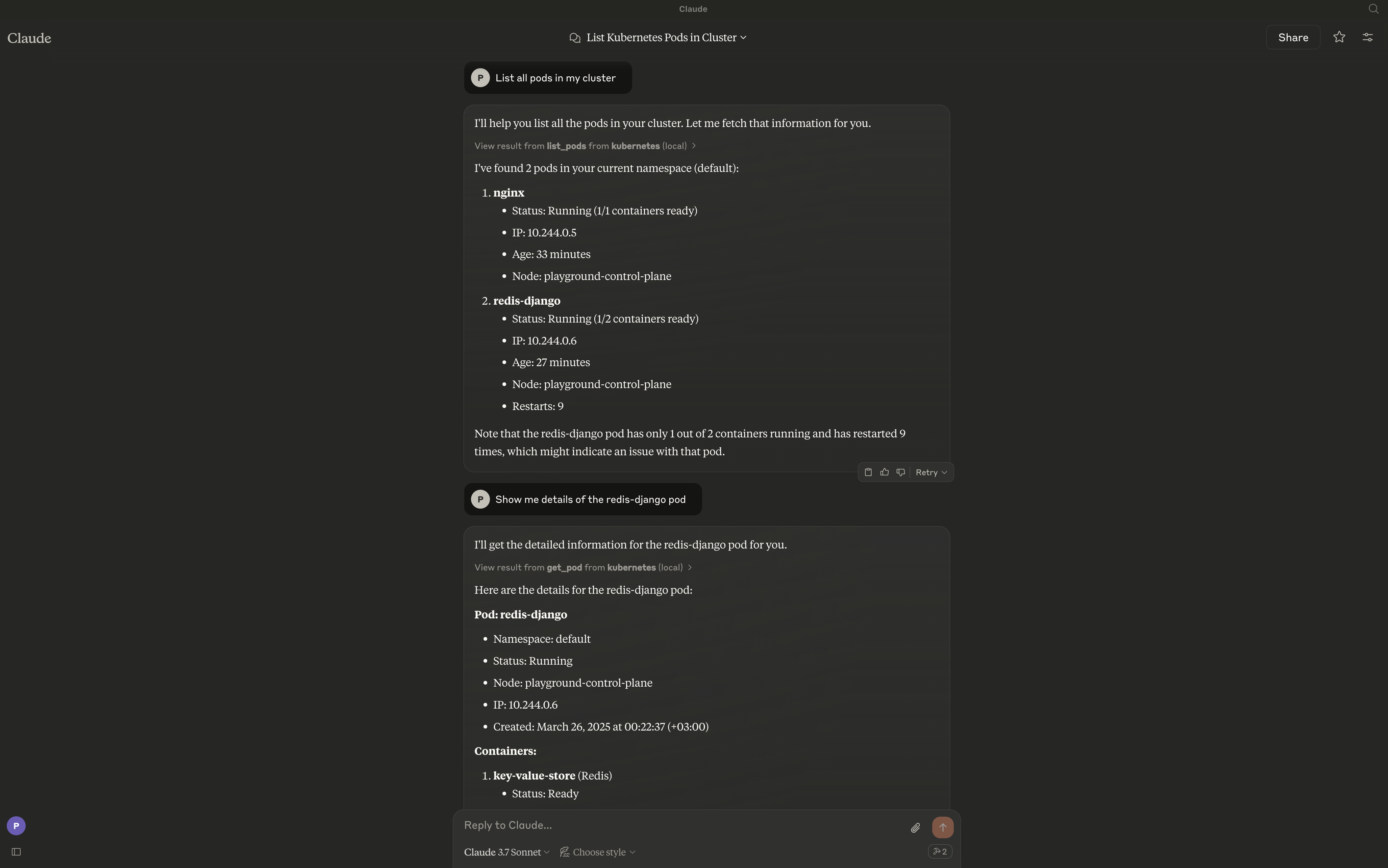
Once configured, you can interact with your cluster using natural language:
- "List all pods in the default namespace"
- "Create a deployment named nginx with 3 replicas using the nginx:latest image"
- "Show me the logs for pod my-app"
- "Delete the service named backend"
- "Create a cronjob that runs every 5 minutes"
- "Create an ingress for my-app with TLS enabled"
- "Port forward service nginx on port 8080:80"
- "Apply this manifest: "
Contributing
Contributions are welcome! Please see our contributing guidelines for more information.
License
This project is licensed under the MIT License.
Frequently asked questions
What is kai?
kai is An MCP Server for Kubernetes
How do I install kai?
Open the GitHub repository and follow its README. Most MCP servers are added to your client's MCP config, then called by your agent.
Is kai open source?
Yes — it is hosted on GitHub at https://github.com/basebandit/kai and has 20 stars.
Related MCP tools
 kubeshark
eBPF-powered network observability for Kubernetes. Indexes L4/L7 traffic with full K8s context, decrypts TLS without keys. Queryable by AI agents via MCP and humans via dashboard.
 radar
radarThe missing open-source Kubernetes UI with a built-in MCP server for AI agents. See what's broken, why, and what changed. Issues, Topology, event timeline, Helm, GitOps, live service traffic, and cluster audits - all in one Go binary.
 mcp-language-server
mcp-language-server gives MCP enabled clients access semantic tools like get definition, references, rename, and diagnostics.
 toolhive
ToolHive makes deploying MCP servers easy, secure and fun Go-based implementation. Trusted by 1300+ developers. Trusted by 1300+ developers.
 MCPJungle
One place to manage & connect to all your MCP servers
 pipelock
Open-source AI agent firewall for MCP security and agent egress. Scans mediated HTTP, MCP, A2A, and WebSocket traffic for exfiltration, SSRF, and prompt injection, and emits mediator-signed action receipts: verifiable audit evidence from outside the agent.
Run your own MCP server? See who uses it and what to fix.
Measure it with TrackMCP