🌍 Terraform Model Context Protocol (MCP) Tool - An experimental CLI tool that enables AI assistants to manage and operate Terraform environments.
Documentation
tfmcp: Terraform Model Context Protocol Tool
*⚠️ This project includes production-ready security features but is still under active development. While the security system provides robust protection, please review all operations carefully in production environments. ⚠️*
tfmcp is a command-line tool that helps you interact with Terraform via the Model Context Protocol (MCP). It allows LLMs to manage and operate your Terraform environments, including:
🎮 Demo
See tfmcp in action with Claude Desktop:
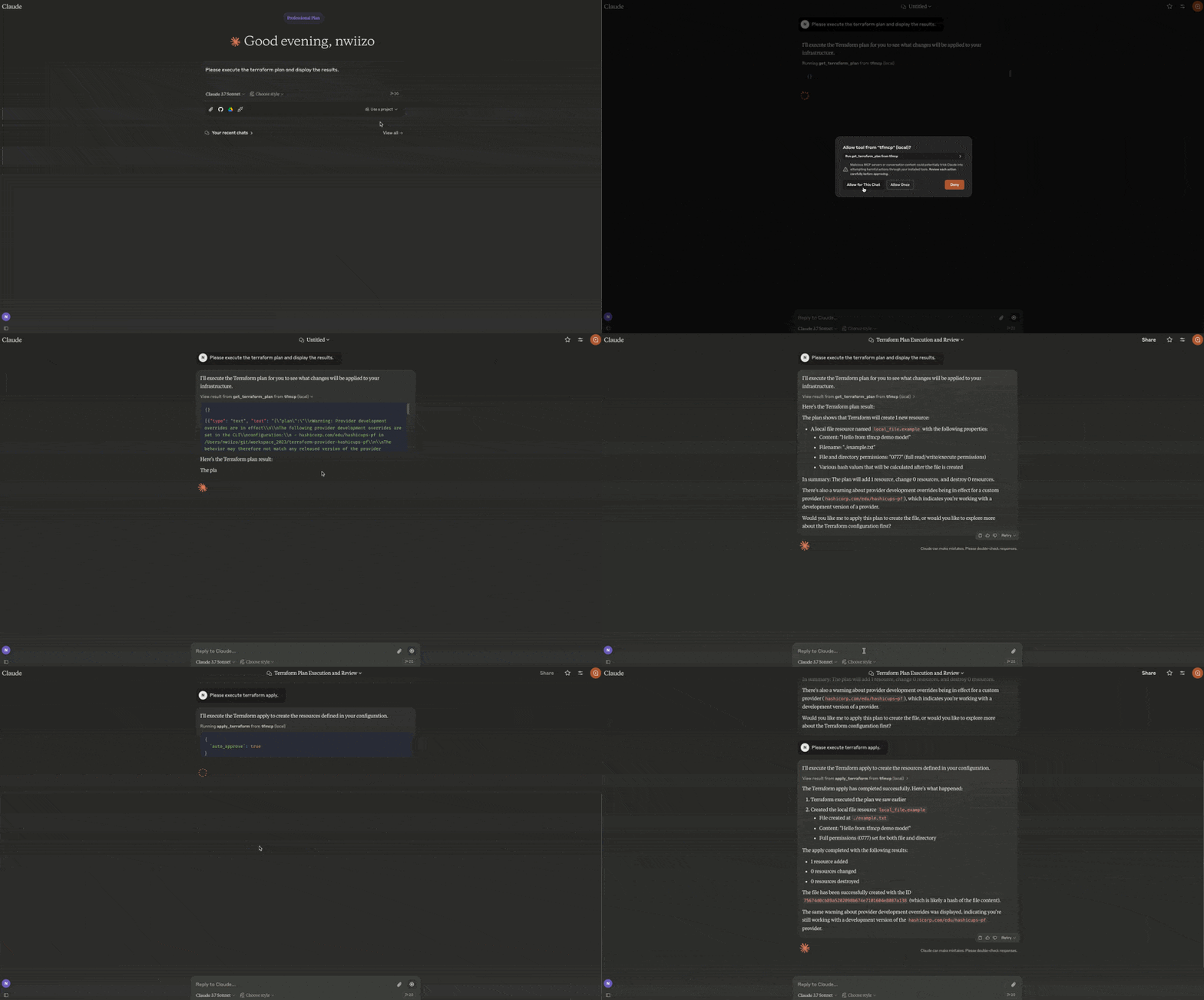
- Reading Terraform configuration files
- Analyzing Terraform plan outputs
- Applying Terraform configurations
- Managing Terraform state
- Creating and modifying Terraform configurations
🎉 Current Release
tfmcp v0.2.1 is the current release:
cargo install tfmcp --version 0.2.1What's new in v0.2.1
- HCP/TFE read coverage and explicitly gated write operations
- Streamable HTTP with loopback-safe Host and Origin validation
- Project inspection, plan review, lockfile checks, and state-safety workflows
- Terraform 1.15.8 CI and container baseline
- Rust module-boundary and duplicate-code release gates
Features
| Area | Capabilities |
|---|---|
| Local Terraform | Validate, format, plan/apply workflows, import guidance, outputs, providers, dependency graphs, refresh-only flows, and guarded state operations |
| Repository intelligence | Entrypoint/project detection, configuration analysis, quality checks, security checks, module health, plan review, and drift/state-safety inspection |
| Registry | Public/private provider, module, and policy lookup with HashiCorp-compatible aliases |
| HCP Terraform / TFE | Organizations, projects, workspaces, runs, plans, applies, variables, policy sets, variable sets, tags, stacks, and gated operations |
| MCP deployment | stdio and Streamable HTTP, toolsets, resources, health/metrics, sessions, Host/Origin validation, rate limits, TLS wiring, and audit logging |
| Packaging | Cargo, Docker/OCI metadata, MCP Registry metadata, Rust Edition 2024 |
Installation
From Source
# Clone the repository
git clone https://github.com/nwiizo/tfmcp
cd tfmcp

# Build and install
cargo install --path .
From Crates.io
cargo install tfmcpUsing Docker
# Clone the repository
git clone https://github.com/nwiizo/tfmcp
cd tfmcp

# Build the Docker image
docker build -t tfmcp .

# Run the container
docker run -it tfmcp
Requirements
- Rust 1.88.0+ (Rust Edition 2024)
- Terraform CLI 1.15.8 installed and available in
PATH - Claude Desktop (for AI assistant integration)
- Docker (optional, for containerized deployment)
Usage
$ tfmcp --help
✨ A CLI tool to manage Terraform configurations and operate Terraform through the Model Context Protocol (MCP).

Usage: tfmcp [OPTIONS] [COMMAND]

Commands:
  mcp       Launch tfmcp as an MCP server
  analyze   Analyze Terraform configurations
  help      Print this message or the help of the given subcommand(s)

Options:
  -c, --config     Path to the configuration file
  -d, --dir        Terraform project directory
  -V, --version          Print version
  -h, --help             Print help
Using Docker
When using Docker, you can run tfmcp commands like this:
# Run as MCP server (default)
docker run -it tfmcp

# Run with specific command and options
docker run -it tfmcp analyze --dir /app/example

# Mount your Terraform project directory
docker run -it -v /path/to/your/terraform:/app/terraform tfmcp --dir /app/terraform

# Set environment variables
docker run -it -e TFMCP_LOG_LEVEL=debug tfmcp
Integrating with Claude Desktop
To use tfmcp with Claude Desktop:
1. If you haven't already, install tfmcp:
cargo install tfmcpAlternatively, you can use Docker:
docker build -t tfmcp .2. Find the path to your installed tfmcp executable:
which tfmcp3. Add the following configuration to ~/Library/Application\ Support/Claude/claude_desktop_config.json:
{
  "mcpServers": {
    "tfmcp": {
      "command": "/path/to/your/tfmcp",  // Replace with the actual path from step 2
      "args": ["mcp"],
      "env": {
        "HOME": "/Users/yourusername",  // Replace with your username
        "PATH": "/usr/local/bin:/usr/bin:/bin:/usr/sbin:/sbin",
        "TERRAFORM_DIR": "/path/to/your/terraform/project"  // Optional: specify your Terraform project
      }
    }
  }
}
If you're using Docker with Claude Desktop, you can set up the configuration like this:
{
  "mcpServers": {
    "tfmcp": {
      "command": "docker",
      "args": ["run", "--rm", "-v", "/path/to/your/terraform:/app/terraform", "tfmcp", "mcp"],
      "env": {
        "TERRAFORM_DIR": "/app/terraform"
      }
    }
  }
}
4. Restart Claude Desktop and enable the tfmcp tool.
5. tfmcp will automatically create a sample Terraform project in ~/terraform if one doesn't exist, ensuring Claude can start working with Terraform right away. The sample project is based on the examples included in the example/demo directory of this repository.
MCP Tools
tfmcp provides 82 MCP tools for AI assistants:
Core Terraform Operations
| Tool | Description |
|---|---|
init_terraform | Initialize Terraform working directory |
get_terraform_plan | Generate and show execution plan |
analyze_plan | NEW Analyze plan with risk scoring and recommendations |
apply_terraform | Apply Terraform configuration |
destroy_terraform | Destroy Terraform-managed infrastructure |
validate_terraform | Validate configuration syntax |
validate_terraform_detailed | Detailed validation with guidelines |
get_terraform_state | Show current state |
analyze_state | NEW Analyze state with drift detection |
review_terraform_plan | Review plan risk, blockers, destructive changes, and recommendations |
summarize_plan_for_pr | Generate markdown plan summary for PR comments |
run_terraform_quality_checks | Run CI-friendly validation, module health, guideline, and lockfile checks |
inspect_state_safety | Inspect state readability, drift risk, lockfile status, and blockers |
detect_drift_candidates | Detect drift candidates from readable state without modifying infrastructure |
prepare_terraform_change | Generate blockers, warnings, and a recommended change sequence |
list_terraform_resources | List all managed resources |
set_terraform_directory | Change active project directory |
Workspace & State (v0.1.9)
| Tool | Description |
|---|---|
terraform_workspace | NEW Manage workspaces (list, show, new, select, delete) |
terraform_import | NEW Import existing resources |
terraform_taint | NEW Taint/untaint resources |
terraform_refresh | NEW Refresh state |
Code & Output (v0.1.9)
| Tool | Description |
|---|---|
terraform_fmt | NEW Format code |
terraform_graph | NEW Generate dependency graph |
terraform_output | NEW Get output values |
terraform_providers | NEW Get provider info with lock file |
check_provider_lockfile | Check .terraform.lock.hcl for reproducible provider selections |
Analysis & Security
| Tool | Description |
|---|---|
analyze_terraform | Analyze configuration |
inspect_terraform_project | Inspect local Terraform directories, modules, and likely entrypoints |
detect_terraform_entrypoints | Detect likely root module entrypoints |
analyze_module_health | Module health with cohesion/coupling metrics |
get_resource_dependency_graph | Resource dependencies visualization |
suggest_module_refactoring | Refactoring suggestions |
get_security_status | Security scan with secret detection |
Registry
| Tool | Description |
|---|---|
search_providers | Search providers (HashiCorp-compatible alias) |
search_terraform_providers | Search providers |
get_provider_details | Provider details (HashiCorp-compatible alias) |
get_provider_info | Provider details |
get_provider_docs | Provider documentation |
get_provider_capabilities | Provider resources, data sources, functions, and guides |
search_modules | Search modules (HashiCorp-compatible alias) |
search_terraform_modules | Search modules |
get_module_details | Module details |
get_latest_module_version | Latest module version |
get_latest_provider_version | Latest provider version |
search_policies | Search Sentinel/OPA policy libraries |
get_policy_details | Policy library details |
HCP Terraform / Terraform Enterprise (Read-only)
| Tool | Description |
|---|---|
get_token_permissions | Inspect configured token account details without exposing the token |
list_terraform_orgs | List visible organizations |
list_terraform_projects | List projects in an organization |
list_workspaces | List workspaces in an organization |
get_workspace_details | Get workspace details by ID or organization/name |
list_runs | List workspace runs |
get_run_details | Get run details |
get_plan_details | Get plan details |
get_plan_logs | Get plan logs |
get_plan_json_output | Get Terraform JSON plan output |
get_apply_details | Get apply details |
get_apply_logs | Get apply logs |
get_workspace_policy_sets | Get policy sets attached to a workspace |
list_workspace_variables | List workspace variables |
list_variable_sets | List organization variable sets |
read_workspace_tags | Read workspace tags |
list_stacks | List Terraform stacks |
get_stack_details | Get Terraform stack details |
search_private_modules | Search private registry modules |
get_private_module_details | Get private registry module details |
search_private_providers | Search private registry providers |
get_private_provider_details | Get private registry provider details |
HCP Terraform / Terraform Enterprise (Gated Operations)
| Tool | Description |
|---|---|
create_workspace | Create a workspace when ENABLE_TF_OPERATIONS=true |
update_workspace | Update workspace settings when ENABLE_TF_OPERATIONS=true |
delete_workspace_safely | Use the safe-delete workspace action when ENABLE_TF_OPERATIONS=true |
create_run | Queue a run when ENABLE_TF_OPERATIONS=true |
action_run | Apply, discard, cancel, force-cancel, or force-execute a run when ENABLE_TF_OPERATIONS=true |
create_workspace_variable | Create a workspace variable when ENABLE_TF_OPERATIONS=true |
update_workspace_variable | Update a workspace variable when ENABLE_TF_OPERATIONS=true |
attach_policy_set_to_workspace | Attach a policy set to a workspace when ENABLE_TF_OPERATIONS=true |
create_variable_set | Create a variable set when ENABLE_TF_OPERATIONS=true |
create_variable_in_variable_set | Create a variable in a variable set when ENABLE_TF_OPERATIONS=true |
delete_variable_in_variable_set | Delete a variable from a variable set when ENABLE_TF_OPERATIONS=true |
attach_variable_set_to_workspaces | Attach a variable set to workspaces when ENABLE_TF_OPERATIONS=true |
detach_variable_set_from_workspaces | Detach a variable set from workspaces when ENABLE_TF_OPERATIONS=true |
create_workspace_tags | Create or attach workspace tags when ENABLE_TF_OPERATIONS=true |
MCP Resources
| URI | Description |
|---|---|
terraform://style-guide / /terraform/style-guide | Terraform style guide |
terraform://module-development / /terraform/module-development | Terraform module development guide |
terraform://best-practices | tfmcp security and operational best practices |
/terraform/providers/{namespace}/name/{name}/version/{version} | HashiCorp-compatible provider documentation template |
Logs and Troubleshooting
The tfmcp server logs are available at:
~/Library/Logs/Claude/mcp-server-tfmcp.logCommon issues and solutions:
- Claude can't connect to the server: Make sure the path to the tfmcp executable is correct in your configuration
- Terraform project issues: tfmcp automatically creates a sample Terraform project if none is found
- Method not found errors: MCP protocol support includes resources/list and prompts/list methods
- Docker issues: If using Docker, ensure your container has proper volume mounts and permissions
Environment Variables
Core Configuration
TERRAFORM_DIR: Set this to specify a custom Terraform project directory. If not set, tfmcp will use the directory provided by command line arguments, configuration files, or fall back to~/terraform. You can also change the project directory at runtime using theset_terraform_directorytool.TFMCP_LOG_LEVEL: Set todebug,info,warn, orerrorto control logging verbosity.TFMCP_DEMO_MODE: Set totrueto enable demo mode with additional safety features.
Security Configuration
ENABLE_TF_OPERATIONS: Set totrueto enable gated HCP Terraform / Terraform Enterprise write tools (default:false)TFMCP_ALLOW_DANGEROUS_OPS: Set totrueto enable apply/destroy operations (default:false)TFMCP_ALLOW_AUTO_APPROVE: Set totrueto enable auto-approve for dangerous operations (default:false)TFMCP_MAX_RESOURCES: Set maximum number of resources that can be managed (default: 50)TFMCP_AUDIT_ENABLED: Set tofalseto disable audit logging (default:true)TFMCP_AUDIT_LOG_FILE: Custom path for audit log file (default:~/.tfmcp/audit.log)TFMCP_AUDIT_LOG_SENSITIVE: Set totrueto include sensitive information in audit logs (default:false)
HCP Terraform / Terraform Enterprise
TFE_ADDRESS: HCP Terraform or Terraform Enterprise base URL (default:https://app.terraform.io)TFE_TOKEN: API token for HCP Terraform / Terraform Enterprise toolsTFE_SKIP_TLS_VERIFY: Set totrueonly for trusted private TFE installations with custom TLSTFE_MAX_RESPONSE_BYTES: Maximum HCP/TFE response bytes returned to MCP clients before truncation (default:65536)
HCP/TFE write tools are disabled by default and fail closed unless
ENABLE_TF_OPERATIONS=true is set. The default toolset keeps write tools
hidden; use --toolsets operations or --toolsets all to expose them.
MCP Transport
TRANSPORT_MODE: MCP transport mode. Usestdio(default) for local desktop clients orstreamable-httpfor remote/CI clients.TRANSPORT_HOST: HTTP bind host for streamable HTTP mode (default:127.0.0.1).TRANSPORT_PORT: HTTP bind port for streamable HTTP mode (default:8080).MCP_ENDPOINT: Streamable HTTP MCP endpoint path (default:/mcp).MCP_HEALTH_ENDPOINT: Health endpoint path (default:/health).MCP_METRICS_ENDPOINT: OTel-compatible JSON metrics snapshot endpoint path (default:/metrics).MCP_SESSION_MODE:statefulfor normal MCP clients orstatelessfor CI-style JSON responses (default:stateful).MCP_HEARTBEAT_INTERVAL: Streamable HTTP SSE keep-alive interval in seconds. Set to0to disable (default:15).MCP_CORS_MODE: Response CORS policy:strict,development, ordisabled(default:strict). MCP request Origin validation remains enabled in all modes.MCP_ALLOWED_ORIGINS: Comma-separated allowed browser origins. Loopback origins are used by default.MCP_ALLOWED_HOSTS: Comma-separated HTTPHost/ authority values accepted by Streamable HTTP. When unset, rmcp's loopback-only defaults apply.MCP_ORGANIZATION_ALLOWLIST: Comma-separated HCP/TFE organization names that remote requests may access.MCP_RATE_LIMIT_GLOBAL: Maximum HTTP requests per minute across the server (0or unset disables).MCP_RATE_LIMIT_SESSION: Maximum HTTP requests per minute perMcp-Session-Id(0or unset disables).MCP_TLS_CERT_FILE: PEM certificate file for HTTPS Streamable HTTP.MCP_TLS_KEY_FILE: PEM private key file for HTTPS Streamable HTTP.
HCP/TFE credentials and addresses are server configuration. tfmcp intentionally
does not accept request-scoped TFE_TOKEN, Authorization, or TFE_ADDRESS
overrides for downstream passthrough. When an organization allowlist is active,
account-wide and ID-only HCP/TFE requests fail closed because their owning
organization cannot be verified locally.
Example streamable HTTP launch:
TRANSPORT_MODE=streamable-http \
TRANSPORT_HOST=127.0.0.1 \
TRANSPORT_PORT=8080 \
tfmcp mcp --toolsets default
The MCP endpoint is http://127.0.0.1:8080/mcp, the health endpoint is
http://127.0.0.1:8080/health, and the metrics endpoint is
http://127.0.0.1:8080/metrics.
Security Considerations
tfmcp includes comprehensive security features designed for production use:
🔒 Built-in Security Features
- Access Controls: Automatic blocking of production/sensitive file patterns
- Operation Restrictions: Dangerous operations (apply/destroy) disabled by default
- Resource Limits: Configurable maximum resource count protection
- Audit Logging: Complete operation tracking with timestamps and user identification
- Directory Validation: Security policy enforcement for project directories
🛡️ Security Best Practices
- Default Safety: Apply/destroy operations are disabled by default - explicitly enable only when needed
- Review Plans: Always review Terraform plans before applying, especially AI-generated ones
- IAM Boundaries: Use appropriate IAM permissions and role boundaries in cloud environments
- Audit Monitoring: Regularly review audit logs at
~/.tfmcp/audit.log - File Patterns: Built-in protection against accessing
prod*,production*, andsecret*patterns - Docker Security: When using containers, carefully consider volume mounts and exposed data
⚙️ Production Configuration
# Recommended production settings
export TFMCP_ALLOW_DANGEROUS_OPS=false    # Keep disabled for safety
export TFMCP_ALLOW_AUTO_APPROVE=false     # Require manual approval
export TFMCP_MAX_RESOURCES=10             # Limit resource scope
export TFMCP_AUDIT_ENABLED=true           # Enable audit logging
export TFMCP_AUDIT_LOG_SENSITIVE=false    # Don't log sensitive data
Contributing
Contributions are welcome! Please feel free to submit a Pull Request.
1. Fork the repository
2. Create your feature branch (git checkout -b feature/amazing-feature)
3. Run quality checks before committing:
cargo fmt --all
   cargo clippy --all-targets --all-features
   cargo test --all-features
4. Commit your changes (git commit -m 'Add some amazing feature')
5. Push to the branch (git push origin feature/amazing-feature)
6. Open a Pull Request
Release Process
Releases are done manually after the local release gate passes:
1. Confirm Cargo.toml, Cargo.lock, server.json, Dockerfile, README, and CHANGELOG.md use the target version.
2. Run the local release gate: ./Release.sh v0.2.1.
3. Review CHANGELOG.md and the generated package.
4. Commit and push main, then confirm CI passed for that exact commit.
5. From the clean commit, publish with ./Release.sh v0.2.1 --publish.
Roadmap
Here are some planned improvements and future features for tfmcp:
For the consolidated v0.2.1 scope and future work, see
docs/releases/v0.2-roadmap.md. Release changes
are recorded in CHANGELOG.md.
Completed
- [x] Basic Terraform Integration
Core integration with Terraform CLI for analyzing and executing operations.
- [x] MCP Server Implementation
Initial implementation of the Model Context Protocol server for AI assistants.
- [x] Automatic Project Creation
Added functionality to automatically create sample Terraform projects when needed.
- [x] Claude Desktop Integration
Support for seamless integration with Claude Desktop.
- [x] Core MCP Methods
Implementation of essential MCP methods including resources/list and prompts/list.
- [x] Error Handling Improvements
Better error handling and recovery mechanisms for robust operation.
- [x] Dynamic Project Directory Switching
Added ability to change the active Terraform project directory without restarting the service.
- [x] Crates.io Publication
Published the package to Crates.io for easy installation via Cargo.
- [x] Docker Support
Added containerization support for easier deployment and cross-platform compatibility.
- [x] Security Enhancements
Comprehensive security system with configurable policies, audit logging, access controls, and production-ready safety features.
- [x] Module Health Analysis (v0.1.6)
Whitebox approach to IaC with cohesion/coupling metrics, health scoring, and refactoring suggestions.
- [x] Resource Dependency Graph (v0.1.6)
Visualization of resource relationships including explicit and implicit dependencies.
- [x] Module Registry Integration (v0.1.6)
Search and explore Terraform modules from the registry.
- [x] Comprehensive Testing Framework
85+ tests including integration tests with real Terraform configurations.
- [x] RMCP SDK Migration (v0.1.8)
Migrated to official RMCP SDK with proper tool annotations for better MCP compliance.
- [x] Future Architect Guidelines (v0.1.8)
Terraform coding standards compliance checks with secret detection and variable quality validation.
In Progress
- [ ] Multi-Environment Support
Add support for managing multiple Terraform environments, workspaces, and modules.
Planned
- [ ] Expanded MCP Protocol Support
Implement additional MCP methods and capabilities for richer integration with AI assistants.
- [ ] Performance Optimization
Optimize resource usage and response times for large Terraform projects.
- [ ] Cost Estimation
Integrate with cloud provider pricing APIs to provide cost estimates for Terraform plans.
- [ ] Interactive TUI
Develop a terminal-based user interface for easier local usage and debugging.
- [ ] Integration with Other AI Platforms
Extend beyond Claude to support other AI assistants and platforms.
- [ ] Plugin System
Develop a plugin architecture to allow extensions of core functionality.
License
This project is licensed under the MIT License - see the LICENSE file for details.
Similar MCP
Based on tags & features
Trending MCP
Most active this week