A comprehensive Model Context Protocol (MCP) server for Apache Druid that provides extensive tools, resources, and AI-assisted prompts for managing and analyzing Druid clusters. Built with Spring Boot and Spring AI, this server enables seamless integration between AI assistants and Apache Druid through standardized MCP protocol.
Documentation
Druid MCP Server
A comprehensive Model Context Protocol (MCP) server for Apache Druid that provides extensive tools, resources, and prompts for managing and analyzing Druid clusters.
*Developed by iunera - Advanced AI and Data Analytics Solutions*
Overview
This MCP server implements a intend-based architecture where profiles picture their usaae intend and the corresponding area of Druid usage. The server provides three main types of MCP components:
- Tools - Executable functions for performing operations
- Resources - Data providers for accessing information
- Prompts - AI-assisted guidance templates
Video Walkthrough
Learn how to integrate AI agents with Apache Druid using the MCP server. This tutorial demonstrates time series data exploration, statistical analysis, and data ingestion using natural language with AI assistants like Claude, ChatGPT, and Gemini.

*Click the thumbnail above to watch the video on YouTube*
🌊 Y̊pipe: AI-Powered UI for Druid
Experience your data like never before with **Y̊pipe (formerly Data-Philter), a local desktop application that makes offline AI practical, designed by iunera. It leverages this Druid MCP Server** to provide a seamless, conversational interface for your Druid cluster.
- Natural Language Queries: Ask questions in plain English and get results instantly.
- Local & Secure: Runs completely locally with support for offline models (CPU/GPU).
- Plug & Play: Works out-of-the-box with the Development Druid Installation.

*The easiest way to test iunera/druid-mcp-server is ypipe.com / https://github.com/iunera/ypipe*
📋 Ypipe Integration Blueprint
For seamless integration, we provide a predefined Ypipe integration blueprint file:
- Blueprint File: druid.ypipe
- Configuration Guide: Ypipe Example Documentation
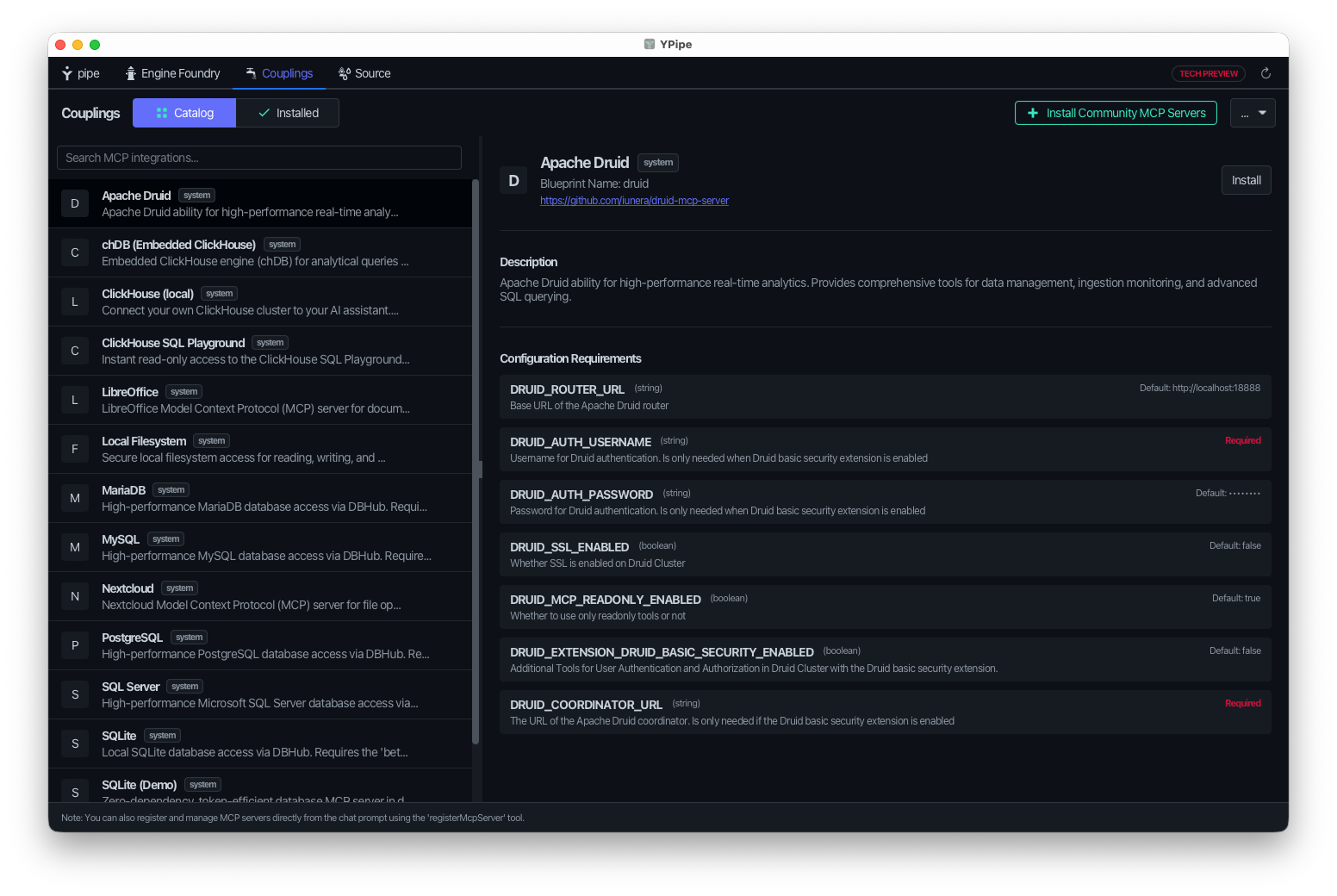
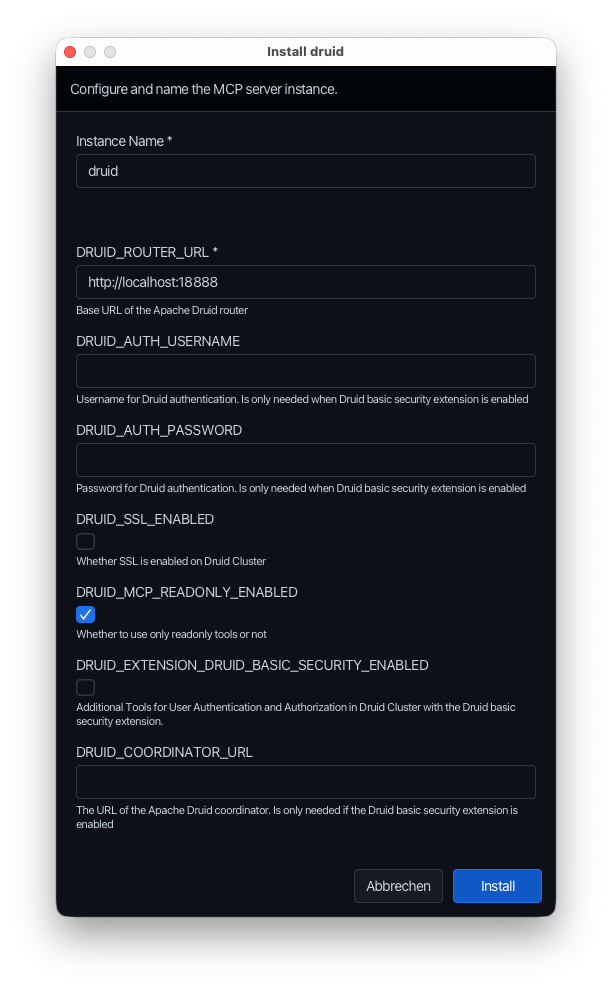
This blueprint allows you to easily connect and configure the Druid MCP server in Ypipe through a visual workspace.
| Ypipe Workspace Flow | Druid Node Configuration |
|---|---|
 |  |
Features
- Pure Java
- Spring AI MCP Server integration
- Tool-based architecture for MCP protocol compliance
- Tool-based Architecture: Complete MCP protocol compliance with automatic JSON schema generation
- Multiple Transport Modes: STDIO, SSE, and Streamable HTTP support including Oauth
- Real-time Communication: Server-Sent Events with streaming capabilities
- Comprehensive error handling
- Customizable Prompt Templates: AI-assisted guidance with template customization
- Comprehensive Error Handling: Graceful error handling with meaningful responses
- Enterprise Ready: Production-grade configuration and security features
MCP Inspector Interface
When connected to an MCP client, you can inspect the available tools, resources, and prompts through the MCP inspector interface:
Available Tools
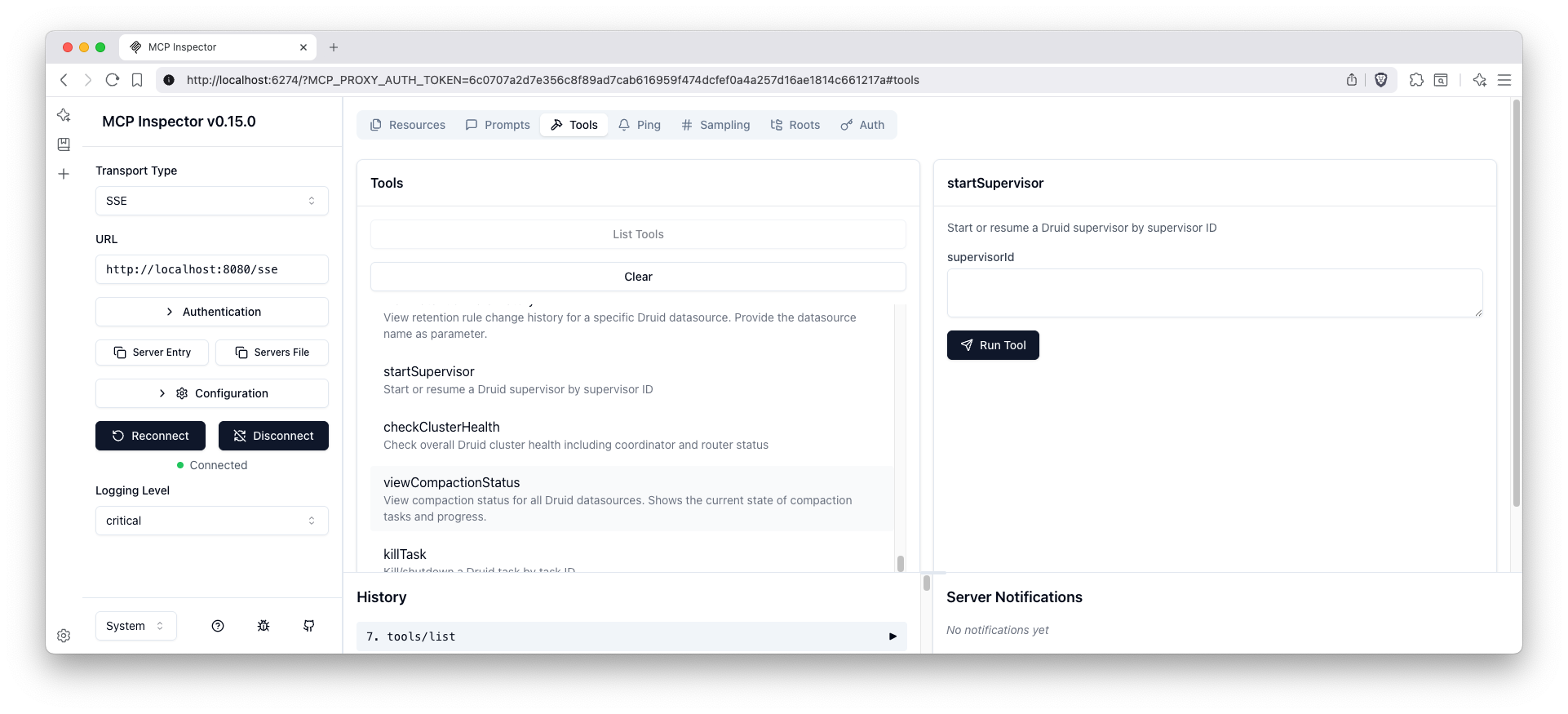
The tools interface shows all available Druid management functions organized by feature areas including data management, ingestion management, and monitoring & health.
Available Resources
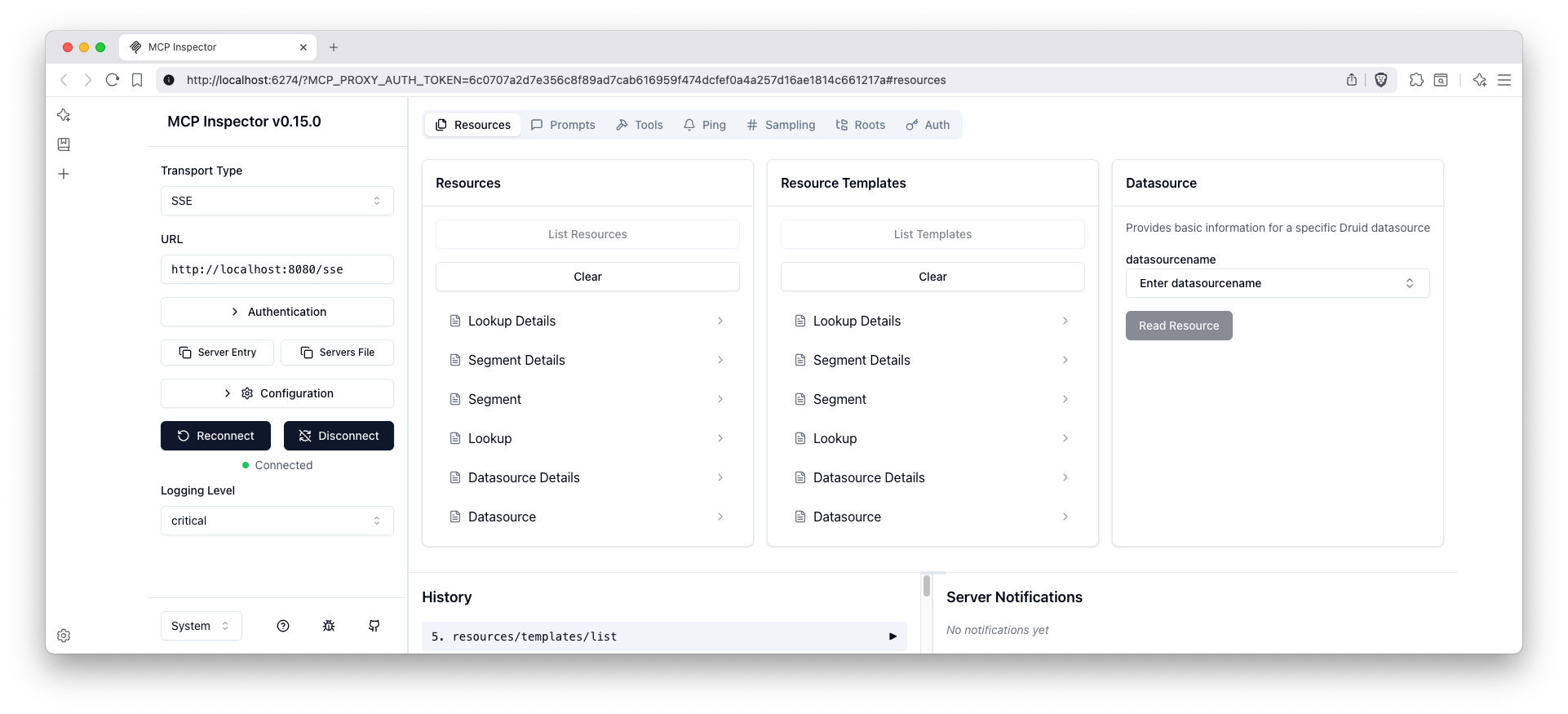
The resources interface displays all accessible Druid data sources and metadata that can be retrieved through the MCP protocol.
Available Prompts
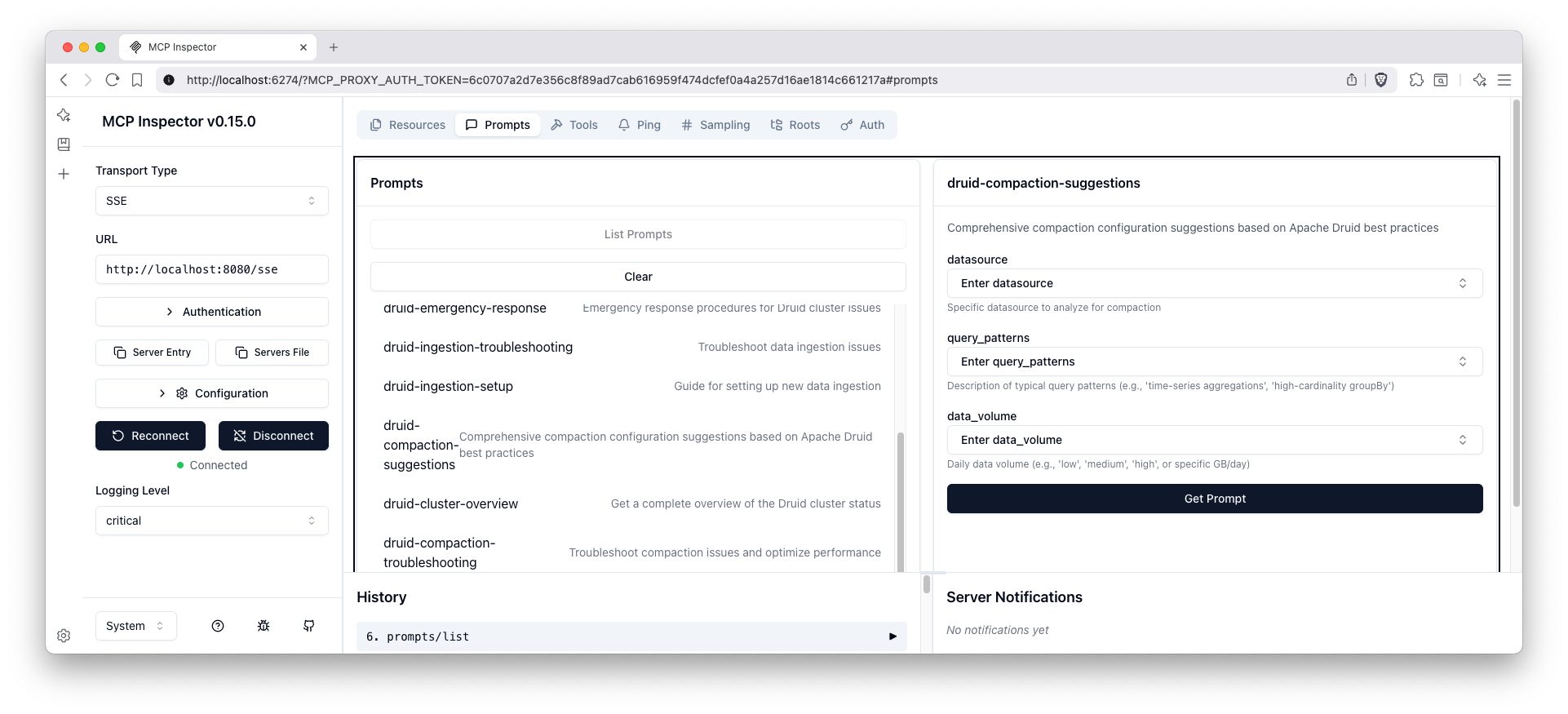
The prompts interface shows all AI-assisted guidance templates available for various Druid management tasks and data analysis workflows.
Quick Start
MCP Configuration for LLMs
A ready-to-use MCP configuration file is provided at mcp-servers-config.json that can be used with LLM clients to connect to this Druid MCP server.
Examples
The configuration includes multiple integration and transport options:
- STDIO (default): see examples/stdio/README.md - server is spawned by the MCP client over STDIO.
- Streamable HTTP (profile: http): see examples/streamable-http/README.md - single /mcp endpoint per MCP 2025-06-18.
- Ypipe Blueprint: see examples/ypipe/README.md - configure and run the Druid MCP Server inside the Ypipe desktop client using the druid.ypipe blueprint.
Docker examples using environment variables:
# STDIO mode (default)
docker run --rm -i \
  -e DRUID_ROUTER_URL=http://your-druid-router:8888 \
  -e DRUID_COORDINATOR_URL=http://your-druid-coordinator:8081 \
  iunera/druid-mcp-server:latest

# HTTP mode (enable profile 'http' and expose /mcp)
docker run -p 8080:8080 \
  -e SPRING_PROFILES_ACTIVE=http,query \
  -e DRUID_ROUTER_URL=http://your-druid-router:8888 \
  -e DRUID_COORDINATOR_URL=http://your-druid-coordinator:8081 \
  iunera/druid-mcp-server:latest
Note on Spring profiles:
- Default profile: stdio,query
- HTTP profile: set SPRING_PROFILES_ACTIVE=http,query to enable Streamable HTTP at /mcp
Prerequisites
- Java 25
- Maven 3.6+
- Apache Druid cluster running with router on port 8888
Build and Run
# Build the application
mvn clean package -DskipTests

# Run the application
java -jar target/druid-mcp-server-2.0.0.jar
The server will start on port 8080 by default.
For detailed build instructions, testing, Docker setup, and development guidelines, see development.md.
Security & Authentication
- Streamable HTTP and SSE transports are secured with OAuth 2.0 by default.
- Clients must send a valid Bearer token in the Authorization header when connecting.
- Example: Authorization: Bearer YOUR_JWT_TOKEN
Environment Variables
-
DRUID_MCP_SECURITY_OAUTH2_ENABLED: - Description: Enables or disables OAuth2 security for client authentication.
- Type: Boolean
- Default:
true(OAuth2 is enabled by default as per the text above) - Usage: Set to
falseto disable OAuth2 authentication. When disabled, clients can access the server without providing OAuth2 tokens. - For enterprise SSO integration (OpenID Connect, Azure AD, Keycloak, etc.), please send an inquiry to consulting@iunera.com and see Contact & Support.
Installation from Maven Central
If you prefer to use the pre-built JAR without building from source, you can download and run it directly from Maven Central.
Prerequisites
- Java 25 JRE only
Download and Run
Download the JAR from Maven Central https://repo.maven.apache.org/maven2/com/iunera/druid-mcp-server/
# STDIO mode (default)
java -jar target/druid-mcp-server-2.0.0.jar

# HTTP mode (profile: http) - exposes /mcp on port 8080
java -Dspring.profiles.active=http \
     -jar target/druid-mcp-server-2.0.0.jar
For Developers
For detailed development information including build instructions, testing guidelines, architecture details, and contributing guidelines, see development.md.
Available Tools by Feature
The MCP server activates tools dynamically based on active Spring profiles (SPRING_PROFILES_ACTIVE). The default configuration runs the server in STDIO mode with the query profile enabled.
Profile: query (Default Active Profile)
Provides safe, read-only data querying and browsing capabilities.
| Tool | Description | Parameters | Druid API Endpoint / Functionality |
|---|---|---|---|
getDatasources | List all available Apache Druid datasources or get detailed schema for a specific datasource. | datasourceName (String, optional), detailed (Boolean, optional) | /druid/v2/sql (queries system catalogs like INFORMATION_SCHEMA.TABLES & COLUMNS) |
getLookups | Get configuration or status of lookups for all or a specific tier. | tier (String, optional), lookupName (String, optional), includeStatus (Boolean, optional) | /druid/coordinator/v1/lookups/config & /status endpoints |
getSegments | Fetch segments metadata or details for a specific segment. | datasource (String, optional), segmentId (String, optional), detailed (Boolean, optional), metadataOnly (Boolean, optional) | /druid/coordinator/v1/datasources/{ds}/segments & system tables (sys.segments via /druid/v2/sql) |
getSegmentLoadQueue | Get the load queue status showing segments currently being loaded. | serverName (String, optional) | /druid/coordinator/v1/loadqueue |
queryDruidSql | Execute a SQL query against Druid datasources. | sqlQuery (String, required) | /druid/v2/sql (Router / Broker SQL endpoint) |
Profile: ops
Provides administrative control over ingestion specs, tasks, streaming supervisors, retention rules, and compaction.
| Tool | Description | Parameters | Druid API Endpoint / Functionality |
|---|---|---|---|
getCompactionConfig | View compaction configuration or configuration change history for datasources. | datasource (String, optional), includeHistory (Boolean, optional) | /druid/coordinator/v1/config/compaction endpoints |
getCompactionStatus | Retrieve the current status of compaction runs and progress. | datasource (String, optional) | /druid/coordinator/v1/compaction/status |
manageCompaction | Add, update, or remove a compaction configuration. | action (Enum: UPSERT, DELETE, required), datasource (String, required), configJson (String, optional) | /druid/coordinator/v1/config/compaction (POST/DELETE) |
manageDatasourceOrSegment | Modify segment states or permanently drop a datasource. | action (Enum: ENABLE_SEGMENT, DISABLE_SEGMENT, KILL_DATASOURCE, required), datasource (String, required), segmentId (String, optional), interval (String, optional) | /druid/coordinator/v1/datasources & segment POST/DELETE |
manageLookup | Create, update, or delete a lookup configuration. | action (Enum: UPSERT, DELETE, required), tier (String, required), lookupName (String, required), configJson (String, optional) | /druid/coordinator/v1/lookups/config (POST/DELETE) |
queryDruidMultiStage | Execute a multi-stage SQL query (MSQ) against Druid datasources as a task. | sqlQuery (String, required) | /druid/v2/sql/task (MSQ execution endpoint) |
queryDruidMultiStageWithContext | Execute a multi-stage SQL query with custom context parameters. | sqlQuery (String, required), contextJson (String, optional) | /druid/v2/sql/task with context configurations |
getMultiStageQueryTaskStatus | Get the status of a multi-stage query task. | taskId (String, required) | /druid/indexer/v1/task/{taskId}/status |
cancelMultiStageQueryTask | Cancel a running multi-stage query task. | taskId (String, required) | /druid/indexer/v1/task/{taskId}/shutdown (POST) |
getRetentionRules | Retrieve retention rules or audit history for a specific datasource or all datasources. | datasource (String, optional), includeHistory (Boolean, optional) | /druid/coordinator/v1/rules |
manageRetentionRules | Update retention rules configuration for a specific datasource. | datasource (String, required), rulesJson (String, required) | /druid/coordinator/v1/rules |
submitIngestion | Submit a Druid ingestion specification or generate a simple batch template. | action (Enum: SUBMIT_SPEC, GENERATE_TEMPLATE, required), payloadJson (String, optional), datasourceName (String, optional), inputSourceType (String, optional), inputSourcePath (String, optional) | /druid/indexer/v1/task (POST) |
getSupervisors | List all supervisors or query details of a specific supervisor. | supervisorId (String, optional) | /druid/indexer/v1/supervisor |
manageSupervisor | Suspend, resume, or terminate a supervisor's execution. | supervisorId (String, required), action (Enum: SUSPEND, RESUME, TERMINATE, required) | /druid/indexer/v1/supervisor/{id}/(suspend/resume/terminate) |
getTasks | List ingestion tasks matching specific states. | state (Enum: RUNNING, PENDING, WAITING, COMPLETED, optional) | /druid/indexer/v1/runningTasks, pendingTasks, waitingTasks, completeTasks |
getTaskDetails | Fetch detailed information, specifications, execution reports, or execution logs for a task. | taskId (String, required), aspect (Enum: STATUS, RAW_DETAILS, SPEC, REPORTS, LOG, required), logOffset (Long, optional) | /druid/indexer/v1/task/{id} spec, status, reports, and log endpoints |
shutdownTask | Kill/shutdown a Druid task. | taskId (String, required) | /druid/indexer/v1/task/{id}/shutdown (POST) |
getClusterStatus | Check overall health or fetch specific metadata/properties from coordinators or routers. | aspect (Enum: OVERALL, COORDINATOR, ROUTER, LEADER, METADATA, PROPERTIES, SELF_DISCOVERY_COORDINATOR, SELF_DISCOVERY_ROUTER, optional) | /status/health, /status/selfDiscovered, /druid/coordinator/v1/leader, /druid/coordinator/v1/config |
getNodesStatus | List registered servers, their detailed status, or single node status. | serverName (String, optional), detailed (Boolean, optional) | /druid/coordinator/v1/servers & /status |
diagnoseCluster | Perform automated diagnostic health checks, configuration audits, or query performance analysis. | mode (Enum: COMPREHENSIVE, QUICK, PERFORMANCE, CONFIGURATION, required) | Orchestrates diagnostic sweeps over active tasks, servers status, segment counts, and APIs |
checkFunctionalityHealth | Validate operations of ingestion systems, supervisor state transitions, and historical query latency. | component (Enum: ALL, SUPERVISORS, HISTORICALS, INGESTION, optional), quick (Boolean, optional) | Orchestrates checks over task execution logs and supervisor statuses |
Profile: permissions
Provides basic security authentication and authorization administration.
[!IMPORTANT]
Basic security tools are only activated if both of the following conditions are met:
1. The
permissionsprofile is activated (spring.profiles.active=permissions).2. The Coordinator URL (
druid.coordinator.url) is set and non-empty.
| Tool | Description | Parameters | Druid API Endpoint / Functionality |
|---|---|---|---|
manageAuthentication | Administer basic security users and credentials. | authenticator (String, required), action (Enum: LIST, GET, CREATE, DELETE, SET_PASSWORD, required), username (String, optional), password (String, optional) | /druid-ext/basic-security/authentication/db/... |
manageAuthorization | Manage security authorization properties, roles, and resource access policies. | authorizer (String, required), action (Enum: LIST_USERS, GET_USER, CREATE_USER, DELETE_USER, LIST_ROLES, GET_ROLE, CREATE_ROLE, DELETE_ROLE, SET_PERMISSIONS, required), name (String, optional), permissionsJson (String, optional) | /druid-ext/basic-security/authorization/db/... |
manageSecurityAssignments | Configure mapping rules assigning roles to users, or retrieve the configured authenticator chains. | authorizer (String, required), action (Enum: ASSIGN_ROLE, UNASSIGN_ROLE, GET_CHAIN, required), username (String, optional), roleName (String, optional) | /druid-ext/basic-security/authorization/db/... & /status/properties |
Profile: health
Provides active health checking, cluster status, diagnostics, and doctor recommendation scans.
| Tool | Description | Parameters | Druid API Endpoint / Functionality |
|---|---|---|---|
getClusterStatus | Check overall health or fetch specific metadata/properties from coordinators or routers. | aspect (Enum: OVERALL, COORDINATOR, ROUTER, LEADER, METADATA, PROPERTIES, SELF_DISCOVERY_COORDINATOR, SELF_DISCOVERY_ROUTER, optional) | /status/health, /status/selfDiscovered, /druid/coordinator/v1/leader, /druid/coordinator/v1/config |
getNodesStatus | List registered servers, their detailed status, or single node status. | serverName (String, optional), detailed (Boolean, optional) | /druid/coordinator/v1/servers & /status |
diagnoseCluster | Perform automated diagnostic health checks, configuration audits, or query performance analysis. | mode (Enum: COMPREHENSIVE, QUICK, PERFORMANCE, CONFIGURATION, required) | Orchestrates diagnostic sweeps over active tasks, servers status, segment counts, and APIs |
checkFunctionalityHealth | Validate operations of ingestion systems, supervisor state transitions, and historical query latency. | component (Enum: ALL, SUPERVISORS, HISTORICALS, INGESTION, optional), quick (Boolean, optional) | Orchestrates checks over task execution logs and supervisor statuses |
Available Resources by Feature
| Feature | Resource URI Pattern | Description | Parameters |
|---|---|---|---|
| Datasource | druid://datasource/{datasourceName} | Access datasource information and metadata | datasourceName (String) |
| Datasource | druid://datasource/{datasourceName}/details | Access detailed datasource information including schema | datasourceName (String) |
| Lookup | druid://lookup/{tier}/{lookupName} | Access lookup configuration and data | tier (String), lookupName (String) |
| Segments | druid://segment/{segmentId} | Access segment metadata and information | segmentId (String) |
Available Prompts by Feature
| Feature | Prompt Name | Description | Parameters |
|---|---|---|---|
| Data Analysis | data-exploration | Guide for exploring data in Druid datasources | datasource (String, optional) |
| Data Analysis | query-optimization | Help optimize Druid SQL queries for better performance | query (String) |
| Cluster Management | health-check | Comprehensive cluster health assessment guidance | None |
| Cluster Management | cluster-overview | Overview and analysis of cluster status | None |
| Ingestion Management | ingestion-troubleshooting | Troubleshoot ingestion issues | issue (String, optional) |
| Ingestion Management | ingestion-setup | Guide for setting up new ingestion pipelines | dataSource (String, optional) |
| Retention Management | retention-management | Manage data retention policies | datasource (String, optional) |
| Compaction | compaction-suggestions | Optimize segment compaction configuration | datasource (String, optional), currentConfig (String, optional), performanceMetrics (String, optional) |
| Compaction | compaction-troubleshooting | Troubleshoot compaction issues | issue (String), datasource (String, optional) |
| Operations | emergency-response | Emergency response procedures and guidance | None |
| Operations | maintenance-mode | Cluster maintenance procedures | None |
Environment Variables Configuration
The application can be configured using environment variables, which is the recommended approach for production environments. Below is a comprehensive list of supported environment variables derived from the application.yaml configuration file.
Druid Connection
DRUID_ROUTER_URL: The URL of the Druid router.DRUID_AUTH_USERNAME: The username for Druid authentication.DRUID_AUTH_PASSWORD: The password for Druid authentication.DRUID_SSL_ENABLED: Enables or disables SSL for Druid connections (true/false).DRUID_SSL_SKIP_VERIFICATION: Skips SSL certificate verification (true/false).DRUID_MCP_SQL_SYNTAX_CORRECTION_ENABLED: Enables or disables automatic SQL syntax correction (default:true). When enabled, automatically formats queries, corrects casing, and quotes identifiers for Druid.DRUID_MCP_SQL_SYNTAX_CORRECTION_CACHE_TTL_MS: The Time-To-Live (TTL) in milliseconds for the cached table and column metadata loaded from Druid (default:300000/ 5 minutes).
MCP Server Configuration
DRUID_MCP_SECURITY_OAUTH2_ENABLED: Enables or disables OAuth2 security for HTTP client authentication (true/false).SPRING_PROFILES_ACTIVE: Comma-separated list of profiles to activate (e.g.query,ops,permissions,healthfor tools capabilities, orhttpto enable HTTP server transport instead of default STDIO).SPRING_AI_MCP_SERVER_NAME: The name of the MCP server.SPRING_AI_MCP_SERVER_PROTOCOL: The protocol used by the MCP server (e.g.,streamable).
General Server Configuration
SERVER_PORT: The port the server listens on.SERVER_SERVLET_SESSION_COOKIE_NAME: The name of the session cookie.SPRING_APPLICATION_NAME: The name of the application.SPRING_CONFIG_IMPORT: Imports additional configuration files.SPRING_MAIN_BANNER_MODE: The mode for the startup banner (e.g.,off).
Logging
LOGGING_FILE_NAME: The name of the log file.LOGGING_LEVEL_ORG_SPRINGFRAMEWORK_SECURITY: The log level for Spring Security (e.g.,DEBUG).
SSL-Encrypted Cluster with Authentication
This section provides comprehensive guidance on connecting to SSL-encrypted Druid clusters with username and password authentication.
Prerequisites
- SSL-enabled Druid cluster with HTTPS endpoints
- Valid username and password credentials for Druid authentication
- SSL certificates properly configured (or ability to skip verification for testing)
Configuration Methods
##### Method 1: Environment Variables (Recommended for Production)
Set the following environment variables before starting the MCP server:
# Druid cluster URL with HTTPS
export DRUID_ROUTER_URL="https://your-druid-cluster.example.com:8888"

# Authentication credentials
export DRUID_AUTH_USERNAME="your-username"
export DRUID_AUTH_PASSWORD="your-password"

# SSL configuration
export DRUID_SSL_ENABLED="true"
export DRUID_SSL_SKIP_VERIFICATION="false"  # Use "true" only for testing

# Start the MCP server
java -jar target/druid-mcp-server-2.0.0.jar
##### Method 2: Runtime System Properties
Pass configuration as JVM system properties:
java -Ddruid.router.url="http://localhost:8888" \
     -Ddruid.auth.username="admin" \
     -Ddruid.auth.password="password" \
     -jar target/druid-mcp-server-2.0.0.jar
SSL Configuration Options
##### Production SSL Setup
For production environments with valid SSL certificates:
export DRUID_ROUTER_URL="https://druid-prod.company.com:8888"
export DRUID_SSL_ENABLED="true"
export DRUID_SSL_SKIP_VERIFICATION="false"
The server will use the system's default truststore to validate SSL certificates.
Authentication Methods
The MCP server supports HTTP Basic Authentication with username and password:
- Username: Set via
DRUID_AUTH_USERNAMEordruid.auth.username - Password: Set via
DRUID_AUTH_PASSWORDordruid.auth.password
The credentials are automatically encoded using Base64 and sent with each request using the Authorization: Basic header.
##### MCP Client Configuration with SSL
Update your mcp-servers-config.json to include environment variables:
{
  "mcpServers": {
    "druid-mcp-server": {
      "command": "docker",
      "args": [
        "run",
        "--rm",
        "-i",
        "-e",
        "DRUID_ROUTER_URL",
        "-e",
        "DRUID_COORDINATOR_URL",
        "-e",
        "DRUID_AUTH_USERNAME",
        "-e",
        "DRUID_AUTH_PASSWORD",
        "-e",
        "DRUID_SSL_ENABLED",
        "-e",
        "DRUID_SSL_SKIP_VERIFICATION",
        "iunera/druid-mcp-server:2.0.0"
      ],
      "env": {
        "DRUID_ROUTER_URL": "http://host.docker.internal:8888",
        "DRUID_COORDINATOR_URL": "http://host.docker.internal:8081",
        "DRUID_AUTH_USERNAME": "",
        "DRUID_AUTH_PASSWORD": "",
        "DRUID_SSL_ENABLED": "false",
        "DRUID_SSL_SKIP_VERIFICATION": "true"
      }
    }
  }
}
MCP Prompt Customization
The server provides extensive prompt customization capabilities through the prompts.properties file located in src/main/resources/.
Prompt Configuration Structure
The prompts.properties file contains:
1. Global Settings: Enable/disable prompts and set watermarks
2. Feature Toggles: Control which prompts are available
3. Custom Variables: Organization-specific information
4. Template Definitions: Full prompt templates for each feature
Overriding Prompts
You can override any prompt template using Java system properties with the -D flag:
Method 1: System Properties (Runtime Override)
java -Dprompts.druid-data-exploration.template="Your custom template here" \
     -jar target/druid-mcp-server-2.0.0.jar
Method 2: Custom Properties File
1. Create a custom properties file (e.g., custom-prompts.properties):
# Custom prompt template
prompts.druid-data-exploration.template=My custom data exploration prompt:\n\
1. Custom step one\n\
2. Custom step two\n\
{datasource_section}\n\
Environment: {environment}
2. Load it at runtime:
java -Dspring.config.additional-location=classpath:custom-prompts.properties \
     -jar target/druid-mcp-server-2.0.0.jar
Available Prompt Variables
All prompt templates support these variables:
| Variable | Description | Example |
|---|---|---|
{environment} | Current environment name | production, staging, dev |
{organizationName} | Organization name | Your Organization |
{contactInfo} | Contact information | your-team@company.com |
{watermark} | Generated watermark | Generated by Druid MCP Server v1.0.0 |
{datasource} | Datasource name (context-specific) | sales_data |
{query} | SQL query (context-specific) | SELECT * FROM sales_data |
Prompt Template Examples
Custom Data Exploration Prompt
prompts.druid-data-exploration.template=Welcome to {organizationName} Druid Analysis!\n\n\
Please help me explore our data:\n\
{datasource_section}\n\
Environment: {environment}\n\
Contact: {contactInfo}\n\n\
{watermark}
Custom Query Optimization Prompt
prompts.druid-query-optimization.template=Query Performance Analysis for {organizationName}\n\n\
Query to optimize: {query}\n\n\
Please provide:\n\
1. Performance bottleneck analysis\n\
2. Optimization recommendations\n\
3. Best practices for our {environment} environment\n\n\
{watermark}
Disabling Specific Prompts
You can disable individual prompts by setting their enabled flag to false:
mcp.prompts.data-exploration.enabled=false
mcp.prompts.query-optimization.enabled=false
Or disable all prompts globally:
mcp.prompts.enabled=falseMCP Integration
This server uses Spring AI's MCP Server framework and supports both STDIO and SSE transports. The tools, resources, and prompts are automatically registered and exposed through the MCP protocol.
Transport Modes
The Druid MCP Server supports multiple transport modes compliant with MCP 2025-06-18 specification:
Streamable HTTP Transport (Recommended)
The new Streamable HTTP transport provides enhanced performance and scalability with support for multiple concurrent clients:
# Default configuration with Streamable HTTP

java -Dspring.profiles.active=http \
     -jar target/druid-mcp-server-2.0.0.jar
# Server available at http://localhost:8080/mcp (configurable endpoint)
Features:
- Single Endpoint: One HTTP endpoint handles both POST and GET requests
- Multiple Clients: Support for concurrent client connections
- Optional SSE Streaming: Server-Sent Events for real-time updates
- Enhanced Security: Origin header validation and authentication
- Backwards Compatibility: Automatic fallback for older MCP clients
- Keep-alive: Configurable connection health monitoring
Security
- The Streamable HTTP and SSE modes are secured with OAuth by default. Your MCP client must obtain and send a valid bearer token when connecting.
- For enterprise SSO integration (OpenID Connect, Azure AD, Keycloak, etc.), please send an inquiry to consulting@iunera.com and see Contact & Support.
STDIO Transport (Command-line Integration)
Perfect for LLM clients and desktop applications:
java -jar target/druid-mcp-server-2.0.0.jarLegacy SSE Transport (Deprecated)
Still supported for backwards compatibility. It is no longer the default and may be removed in a future version.
Note: The SSE endpoint is secured with OAuth by default. Clients must include a valid bearer token when connecting. For SSO integration support, see Contact & Support.
Metrics Collection
To enhance the product and understand usage patterns, this server collects anonymous usage metrics. This data helps prioritize new features and improvements. You can opt-out of anonymous metrics collection by setting the druid.mcp.metrics.enabled to `false.
🐳 Development Druid Installation
For local development, testing, and learning, a complete Docker Compose setup for running a full Apache Druid cluster is available at iunera/druid-local-cluster-installer.
This setup is the recommended way to get a Druid cluster running for use with this MCP server.
Key Features:
- Complete Druid Cluster: Includes all core Druid services (Coordinator, Broker, Historical, MiddleManager, Router).
- One-Command Install: Automated scripts for macOS, Linux, and Windows.
- Cross-Platform: Runs anywhere Docker is available.
- Pre-configured: Sensible defaults for local development.
- Basic Security Enabled: Pre-configured admin user (
admin/password). - Ready for Ypipe: Designed to work out-of-the-box with
iunera/ypipe.
Related Projects
This Druid MCP Server is part of a comprehensive ecosystem of Apache Druid tools and extensions developed by iunera. These complementary projects enhance different aspects of Druid cluster management and data ingestion:
🔧 Druid Cluster Configuration
Advanced configuration management and deployment tools for Apache Druid clusters. This project provides:
- Automated Cluster Setup: Streamlined configuration templates for different deployment scenarios
- Configuration Management: Best practices and templates for production Druid clusters
- Deployment Automation: Tools and scripts for consistent cluster deployments
- Environment-Specific Configs: Optimized configurations for development, staging, and production environments
Integration with Druid MCP Server: The cluster configurations provided by this project work seamlessly with the monitoring and management capabilities of the Druid MCP Server, enabling comprehensive cluster lifecycle management.
📊 Code Ingestion Druid Extension
A specialized Apache Druid extension for ingesting and analyzing code-related data and metrics. This extension enables:
- Code Metrics Ingestion: Specialized parsers for code analysis data and software metrics
- Developer Analytics: Tools for analyzing code quality, complexity, and development patterns
- CI/CD Integration: Seamless integration with continuous integration and deployment pipelines
- Custom Data Formats: Support for various code analysis tools and formats
Integration with Druid MCP Server: This extension expands the ingestion capabilities that can be managed through the MCP server's ingestion management tools, providing specialized support for code analytics use cases.
Why Use These Together?
- Complete Ecosystem: From cluster setup to specialized data ingestion and management
- Consistent Architecture: All projects follow similar design principles and integration patterns
- Enhanced Capabilities: Each project extends different aspects of the Druid ecosystem
- Production Ready: Battle-tested configurations and extensions for enterprise deployments
Roadmap
- Druid Auto Compaction: Intelligent automatic compaction configuration
- MCP Auto Completion: Enhanced autocomplete functionality with sampling using McpComplete
- MCP Notifications: Real-time notifications for MCP operations
- Proper Observability: Comprehensive metrics and tracing
- Enhanced Monitoring: Advanced cluster monitoring and alerting capabilities
- Advanced Analytics: Machine learning-powered insights and recommendations
- Kubernetes Support: Proper deployment on Kubernetes
---
About iunera
This Druid MCP Server is developed and maintained by **iunera**, a leading provider of advanced AI and data analytics solutions.
iunera specializes in:
- AI-Powered Analytics: Cutting-edge artificial intelligence solutions for data analysis
- Enterprise Data Platforms: Scalable data infrastructure and analytics platforms (Druid, Flink, Kubernetes, Kafka, Spring)
- Model Context Protocol (MCP) Solutions: Advanced MCP server implementations for various data systems
- Custom AI Development: Tailored AI solutions for enterprise needs
As veterans in Apache Druid iunera deployed and maintained a large number of solutions based on Apache Druid in productive enterprise grade scenarios.
Need Expert Apache Druid Consulting?
Maximize your return on data with professional Druid implementation and optimization services. From architecture design to performance tuning and AI integration, our experts help you navigate Druid's complexity and unlock its full potential.
**Get Expert Druid Consulting →**
Need Enterprise MCP Server Development Consulting?
ENTERPRISE AI INTEGRATION & CUSTOM MCP (MODEL CONTEXT PROTOCOL) SERVER DEVELOPMENT
Iunera specializes in developing production-grade AI agents and enterprise-grade LLM solutions, helping businesses move beyond generic AI chatbots. They build secure, scalable, and future-ready AI infrastructure, underpinned by the Model Context Protocol (MCP), to connect proprietary data, legacy systems, and external APIs to advanced AI models.
**Get Enterprise MCP Server Development Consulting →**
For more information about our services and solutions, visit www.iunera.com.
Contact & Support
Need help? Let
- Website: https://www.iunera.com
- Professional Services: Contact us through email for Apache Druid enterprise consulting, support and custom development
- Open Source: This project is open source and community contributions are welcome
---
*© 2026 iunera. Licensed under the Apache License 2.0.*
Similar MCP
Based on tags & features
Trending MCP
Most active this week