Open source calendly mcp server
Documentation
Calendly MCP Server
A Model Context Protocol (MCP) server for integrating with the Calendly API. This server provides tools to interact with Calendly's scheduling platform, allowing you to retrieve user information, list events, manage invitees, cancel events, and schedule meetings directly via the new Scheduling API.
Features
Core Calendly Integration
- User Information: Get current authenticated user details
- Event Management: List, retrieve, and cancel scheduled events
- Invitee Management: List and manage event invitees
- Organization: List organization memberships
NEW: Scheduling API Integration
- Direct Meeting Scheduling: Book meetings programmatically without redirects
- Event Type Discovery: List available event types for scheduling
- Real-Time Availability: Check available time slots for any event type
- Complete Booking Flow: End-to-end scheduling with calendar sync and notifications
- Location Support: Zoom, Google Meet, Teams, physical locations, and custom options
Installation
Option 1: NPX (Recommended)
Run directly without installation:
npx calendly-mcp-serverOption 2: Manual Installation
1. Clone this repository:
git clone https://github.com/meAmitPatil/calendly-mcp-server.git
cd calendly-mcp-server
2. Install dependencies:
npm install3. Build the project:
npm run buildConfiguration
Authentication
This server supports two authentication methods:
Option 1: Personal Access Token (PAT)
For internal applications or personal use:
1. Get your Personal Access Token from your Calendly Integrations page
2. Select API and webhooks → Get a token now
3. Set the environment variable:
export CALENDLY_API_KEY="your_personal_access_token_here"Option 2: OAuth 2.0
For public applications that multiple users will use:
1. Create a developer account at developer.calendly.com
2. Create an OAuth application to get your client credentials
3. Set the environment variables:
export CALENDLY_CLIENT_ID="your_client_id_here"
export CALENDLY_CLIENT_SECRET="your_client_secret_here"
4. Optionally, if you already have tokens:
export CALENDLY_ACCESS_TOKEN="your_access_token_here"
export CALENDLY_REFRESH_TOKEN="your_refresh_token_here"
Optional User Context (Recommended)
For better performance and automatic defaults, you can set user-specific URIs:
export CALENDLY_USER_URI="https://api.calendly.com/users/your_user_id"
export CALENDLY_ORGANIZATION_URI="https://api.calendly.com/organizations/your_org_id"
These can be obtained by running get_current_user after authentication. When set, the server will automatically use these as defaults for API calls that require user context.
MCP Configuration
Add the server to your MCP client configuration (e.g., Claude Desktop):
Option 1: Using NPX (Recommended)
For Personal Access Token:
{
  "mcpServers": {
    "calendly": {
      "command": "npx",
      "args": ["calendly-mcp-server"],
      "env": {
        "CALENDLY_API_KEY": "your_personal_access_token_here",
        "CALENDLY_USER_URI": "https://api.calendly.com/users/your_user_id",
        "CALENDLY_ORGANIZATION_URI": "https://api.calendly.com/organizations/your_org_id"
      }
    }
  }
}
For OAuth 2.0:
{
  "mcpServers": {
    "calendly": {
      "command": "npx",
      "args": ["calendly-mcp-server"],
      "env": {
        "CALENDLY_CLIENT_ID": "your_client_id_here",
        "CALENDLY_CLIENT_SECRET": "your_client_secret_here",
        "CALENDLY_ACCESS_TOKEN": "your_access_token_here",
        "CALENDLY_REFRESH_TOKEN": "your_refresh_token_here",
        "CALENDLY_USER_URI": "https://api.calendly.com/users/your_user_id",
        "CALENDLY_ORGANIZATION_URI": "https://api.calendly.com/organizations/your_org_id"
      }
    }
  }
}
Option 2: Using Local Installation
For Personal Access Token:
{
  "mcpServers": {
    "calendly": {
      "command": "node",
      "args": ["path/to/calendly-mcp-server/dist/index.js"],
      "env": {
        "CALENDLY_API_KEY": "your_personal_access_token_here",
        "CALENDLY_USER_URI": "https://api.calendly.com/users/your_user_id",
        "CALENDLY_ORGANIZATION_URI": "https://api.calendly.com/organizations/your_org_id"
      }
    }
  }
}
For OAuth 2.0:
{
  "mcpServers": {
    "calendly": {
      "command": "node",
      "args": ["path/to/calendly-mcp-server/dist/index.js"],
      "env": {
        "CALENDLY_CLIENT_ID": "your_client_id_here",
        "CALENDLY_CLIENT_SECRET": "your_client_secret_here",
        "CALENDLY_ACCESS_TOKEN": "your_access_token_here",
        "CALENDLY_REFRESH_TOKEN": "your_refresh_token_here",
        "CALENDLY_USER_URI": "https://api.calendly.com/users/your_user_id",
        "CALENDLY_ORGANIZATION_URI": "https://api.calendly.com/organizations/your_org_id"
      }
    }
  }
}
Available Tools (12 Total)
*All tools work seamlessly through Claude Desktop or any MCP client*
OAuth 2.0 Tools
get_oauth_url
Generate OAuth authorization URL for user authentication.
Parameters:
redirect_uri(required): The redirect URI for your OAuth applicationstate(optional): Optional state parameter for security
exchange_code_for_tokens
Exchange authorization code for access and refresh tokens.
Parameters:
code(required): The authorization code from OAuth callbackredirect_uri(required): The redirect URI used in authorization
refresh_access_token
Refresh access token using refresh token.
Parameters:
refresh_token(required): The refresh token to use
API Tools
get_current_user
Get information about the currently authenticated user.
list_events
List scheduled events with optional filtering.
Parameters:
user_uri(optional): URI of the user whose events to list (usesCALENDLY_USER_URIif not provided)organization_uri(optional): URI of the organization to filter eventsstatus(optional): Filter by status ("active" or "canceled")max_start_time(optional): Maximum start time (ISO 8601 format)min_start_time(optional): Minimum start time (ISO 8601 format)count(optional): Number of events to return (default 20, max 100)
get_event
Get details of a specific event.
Parameters:
event_uuid(required): UUID of the event to retrieve
list_event_invitees
List invitees for a specific event.
Parameters:
event_uuid(required): UUID of the eventstatus(optional): Filter by status ("active" or "canceled")email(optional): Filter by email addresscount(optional): Number of invitees to return (default 20, max 100)
cancel_event
Cancel a specific event.
Parameters:
event_uuid(required): UUID of the event to cancelreason(optional): Reason for cancellation
list_organization_memberships
List organization memberships for the authenticated user.
Parameters:
user_uri(optional): URI of the user (usesCALENDLY_USER_URIif not provided)organization_uri(optional): URI of the organizationemail(optional): Filter by emailcount(optional): Number of memberships to return (default 20, max 100)
Scheduling API Tools
list_event_types
List available event types for scheduling meetings.
Parameters:
user(optional): URI of the user whose event types to listorganization(optional): URI of the organization to filter event typescount(optional): Number of event types to return (default 20, max 100)
get_event_type_availability
Get available time slots for a specific event type.
Parameters:
event_type(required): URI of the event type to check availability forstart_time(optional): Start time for availability window (ISO 8601 format)end_time(optional): End time for availability window (ISO 8601 format)
schedule_event
Schedule a meeting by creating an invitee for a specific event type and time.
Requirements: Paid Calendly plan (Standard or higher)
Parameters:
event_type(required): URI of the event type to schedulestart_time(required): Start time for the event (ISO 8601 UTC format)invitee_email(required): Email address of the inviteeinvitee_timezone(required): Timezone of the invitee (e.g., America/New_York)invitee_name(optional): Full name of the inviteeinvitee_first_name(optional): First name of the inviteeinvitee_last_name(optional): Last name of the inviteeinvitee_phone(optional): Phone number for SMS reminders (E.164 format)location_kind(optional): Meeting location type (zoom_conference, google_conference, physical, etc.)location_details(optional): Location details (required for physical meetings)event_guests(optional): Array of additional email addresses (max 10)questions_and_answers(optional): Array of question/answer pairsutm_source,utm_campaign,utm_medium(optional): UTM tracking parameters
Usage Examples
Once configured with your MCP client, you can use these tools:
Live Demo
Here's the MCP server in action with Claude Desktop:
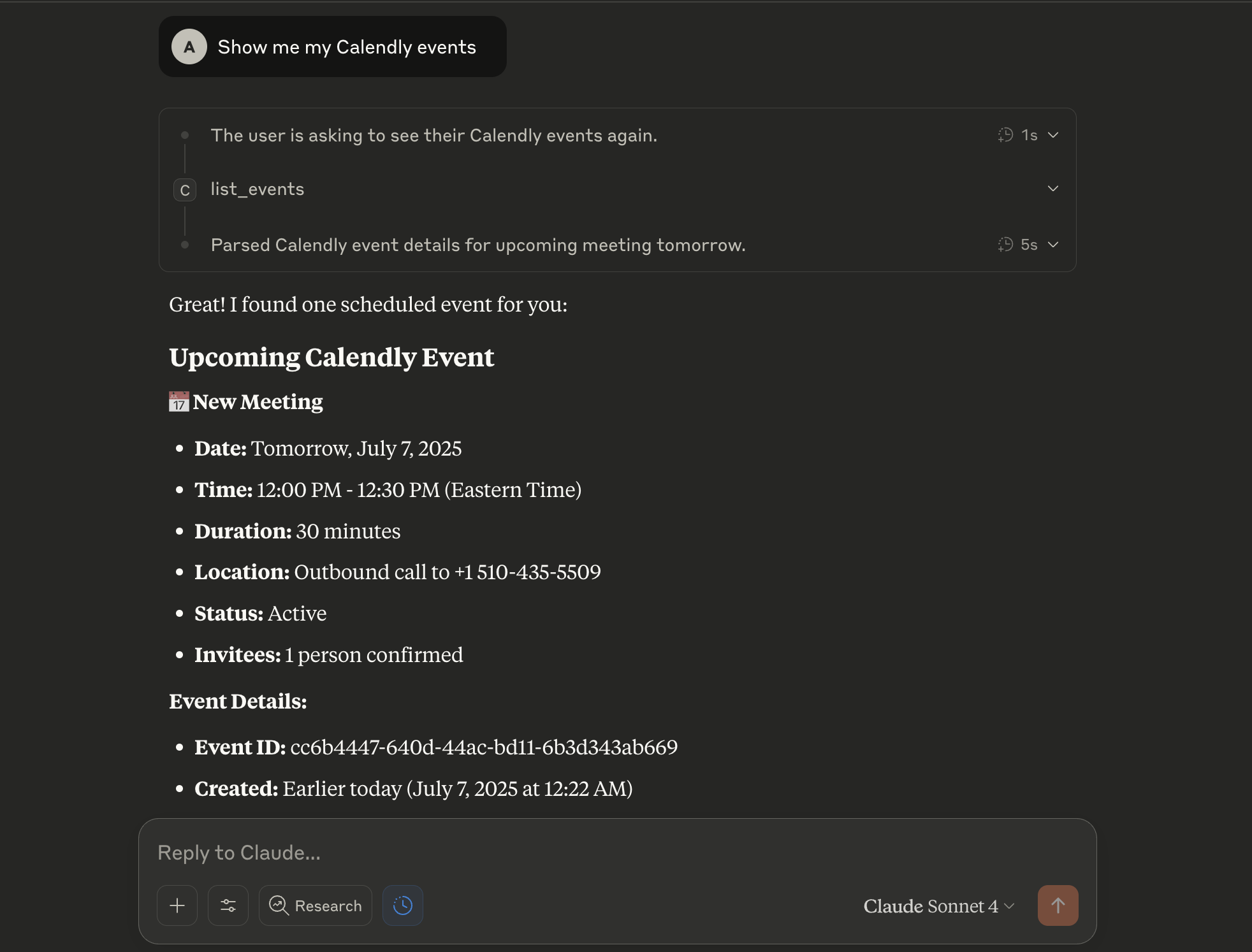
*Example: User asks "Show me my Calendly events" and gets formatted event details including date, time, duration, location, and invitee information.*
OAuth Flow Examples:
# Generate OAuth URL
get_oauth_url redirect_uri="https://myapp.com/auth/callback"

# Exchange code for tokens (after user authorizes)
exchange_code_for_tokens code="AUTHORIZATION_CODE" redirect_uri="https://myapp.com/auth/callback"

# Refresh access token
refresh_access_token refresh_token="REFRESH_TOKEN"
API Examples:
# Get current user information
get_current_user

# List recent events
list_events count=10

# Get specific event details
get_event event_uuid="EVENT_UUID_HERE"

# List invitees for an event
list_event_invitees event_uuid="EVENT_UUID_HERE"

# Cancel an event
cancel_event event_uuid="EVENT_UUID_HERE" reason="Meeting no longer needed"
Scheduling API Examples:
# List available event types
list_event_types

# Check availability for a specific event type
get_event_type_availability event_type="https://api.calendly.com/event_types/AAAAAAAAAAAAAAAA"

# Schedule a meeting (requires paid plan)
schedule_event event_type="https://api.calendly.com/event_types/AAAAAAAAAAAAAAAA" start_time="2025-10-21T19:00:00Z" invitee_email="client@company.com" invitee_name="John Smith" invitee_timezone="America/New_York" location_kind="zoom_conference"
🎯 Claude Desktop Examples:
# Natural language commands that work in Claude Desktop:
"Show me my event types"
"Check availability for my 30-minute consultation next week"
"Schedule a meeting with john@company.com for tomorrow at 2 PM"
"Book a client onboarding call for Friday"
API Limitations
- Scheduling API: Requires paid Calendly plan (Standard or higher)
- Event Rescheduling: Not supported via API (only cancellation)
- Event Type Creation: Cannot create new event types via API
- Rate Limits: Standard Calendly API rate limits apply
Troubleshooting
NPX Issues
- "command not found: npx": Install Node.js 18+ which includes npx
- NPX downloads every time: This is normal behavior; NPX caches packages for faster subsequent runs
- Permission errors: Ensure you have write access to npm cache directory (
npm config get cache) - Network issues: Use
npx --offline calendly-mcp-serverto use cached version
Authentication Issues
- "No authentication token available": Set
CALENDLY_API_KEYenvironment variable - **400 errors on
list_events**: SetCALENDLY_USER_URIenvironment variable or provideuser_uriparameter - Permission errors: Ensure API key has correct permissions
Scheduling API Issues
- **403 Forbidden on
schedule_event**: Requires paid Calendly plan (Standard or higher) - 400 Bad Request: Check that event_type URI is valid and start_time is in correct UTC format
- Invalid time slot: Use
get_event_type_availabilityto verify the time slot is available
General Issues
- TypeScript errors: Ensure Node.js version 18+ is installed
- Module not found: Run
npm run buildif using local installation
Development
Quick Start for Development
# Test with NPX (recommended for users)
npx calendly-mcp-server

# Test with MCP Inspector
npx @modelcontextprotocol/inspector npx calendly-mcp-server

# Clone for development
git clone
cd calendly-mcp-server
npm install
npm run build
Scripts
npm run build: Build the TypeScript codenpm run dev: Run in development mode with auto-reloadnpm start: Run the built server
Project Structure
src/
├── index.ts          # Main server implementation
├── types.ts          # TypeScript type definitions (if needed)
└── utils.ts          # Utility functions (if needed)
Contributing
1. Fork the repository
2. Create a feature branch
3. Make your changes
4. Test thoroughly
5. Submit a pull request
License
MIT License - see LICENSE file for details.
Support
For issues with this MCP server, please create an issue in the repository.
For Calendly API documentation, visit the Calendly Developer Portal.
Similar MCP
Based on tags & features
Trending MCP
Most active this week